

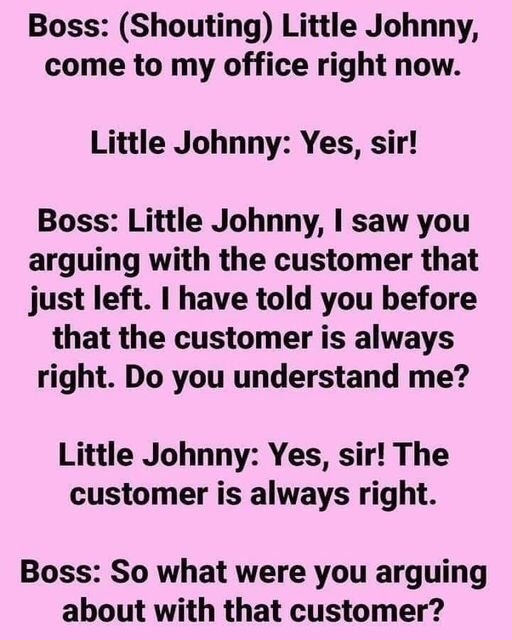
Most bosses probably would have done the latter, but one could argue that Johnny had just given his manager a valuable reminder: leadership isn’t just about repeating slogans. It’s about context, fairness, and knowing when to bend the rules. In many workplaces, there’s an unspoken tension between management’s expectations and employees’ realities.
Bosses want smooth operations, happy customers, and clean reputations. Employees, meanwhile, are the ones on the frontlines, navigating the daily grind of complaints, demands, and occasional hostility. When bosses repeat “the customer is always right” without considering their staff’s well-being, they risk undermining morale and loyalty.
What Johnny did, though cheeky, underscores something deeper: employees also deserve respect. Their perspective matters. A company that treats staff as disposable tools in the name of customer satisfaction risks losing not only workers but also its soul.
After all, a business is nothing without the people who run it. Ironically, in this story, Johnny both obeyed and disobeyed at the same time. He obeyed the rule—agreeing that the customer was right.
But by doing so, he also subtly challenged his boss, pointing out how blindly following such a phrase can lead to humiliation rather than professionalism. It’s a reminder for everyone—whether you’re a boss, a worker, or even a customer—that words have weight, and rules need wisdom. Customers deserve fair treatment, but so do employees.
Respect should go both ways. And as for Johnny? Well, he may have gotten a stern talking-to, but among his colleagues, he became something of a legend.
His quick wit turned an ordinary workplace scolding into a story people would remember—and laugh about—for years. So, is the customer always right? Perhaps not.
Sometimes, as Johnny cleverly pointed out, they’re only right when it’s convenient. The real lesson is balance: knowing when to listen, when to lead, and when to laugh at ourselves. Because at the end of the day, a little humor can save even the most uncomfortable situations—especially when the joke lands squarely on the boss.

