

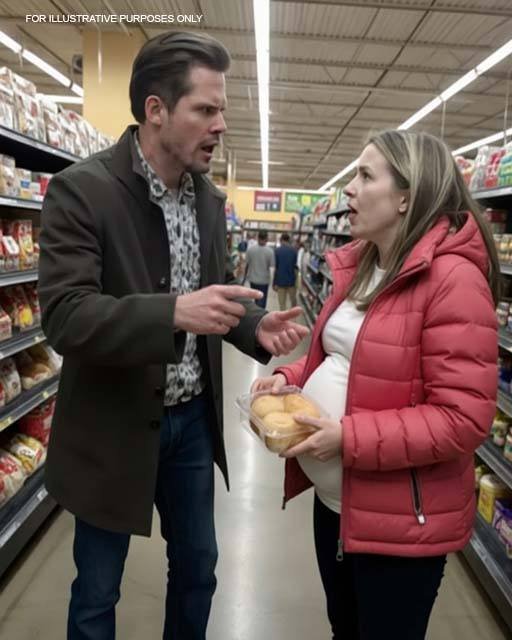
I froze, hand hovering over the bag. “You’re seriously getting those?” he scoffed, loud enough that two nearby shoppers turned their heads. “Three-dollar buns?
What are we, hobos?”
I blinked at him, stunned by the harshness in his voice. “They’re perfectly good,” I said quietly. “They’re trash,” he muttered.
“You always act like we’re broke. It’s embarrassing.”
I felt my face heat not with shame, but something else, something simmering. “We are broke.
I’m the only one working right now.”
His expression twisted, not into guilt but annoyance, like I’d inconvenienced him with a fact he didn’t like. “Here we go again,” he said, throwing his hands up. “You just love reminding me, don’t you?”
“I’m not trying to—”
“Yes, you are.
You act like I’m some deadbeat. You don’t respect me at all.”
A burst of pain shot through my chest. All I’d ever done was try to keep us afloat.
Try to stay patient, even hopeful. Try to believe he was still the man I thought he was. “I’m just trying to make our money stretch,” I whispered.
“We have a baby on the way. Every dollar matters.”
He snorted. “Oh, please.
You think the baby is going to care what kind of bread we eat? You think anyone is going to look at us and say, ‘Wow, such responsible parents—they buy cheap buns’?”
“That’s not the point.”
“What is the point, then?”
I stared at him, really stared, for the first time in weeks. His jaw was clenched, his eyebrows pulled together, his posture radiating frustration—as if I, not his lack of effort, not our situation, not reality, was the problem.
“I’m doing my best,” I said. “And I need you to start doing yours.”
He laughed again. Actually laughed.
“In case you forgot,” he said sharply, “you’re the one who got pregnant.”
The world seemed to tilt. For a moment, I forgot how to breathe. I set the buns back onto the shelf.
My hands were shaking. “What did you just say?” My voice came out barely above a whisper. He shrugged with a nonchalance that cut deeper than any insult.
“I’m just saying you act like I owe you something. Like it’s my fault you’re stressed. You decided to keep the baby.
That was your choice.”
The words landed like blows. “You were there,” I said quietly. “You said we’d do this together.”
“Yeah, well, I didn’t think you’d turn into—”
“Into what?”
He hesitated, then muttered, “Into someone naggy and emotional and impossible to please.”
A sharp sting pricked at my eyes.
I turned away, pretending to study the bread. Anything to hide the hurt on my face. “What do you want from me?” I asked.
He scoffed. “To stop being cheap, for a start.”
The sentence was simple, but its impact wasn’t. It hit me in a place deeper than the argument, deeper than the groceries, deeper even than the pregnancy.
This wasn’t about bread. This was the moment he revealed who he truly was. And whether I wanted to admit it or not, something inside me began to crack.
Before I could respond, someone cleared their throat from behind us. “I couldn’t help overhearing.”
We both turned. A man stood there—mid-fifties maybe, wearing a navy jacket, glasses perched halfway down his nose.
He was holding a loaf of bread and studying my partner with a look that wasn’t confrontational, but wasn’t gentle either. “I don’t usually butt into private conversations,” the man said. “But I think she deserves better than being embarrassed in a grocery store over something as trivial as buns.”
My partner bristled instantly.
“Mind your own business.”
The man didn’t flinch. “I am. I’m shopping.
You’re the one making a scene.”
I saw my partner’s chest puff up, the familiar signs of a temper brewing, and panic sparked in me. “Let’s just go,” I said quickly, trying to diffuse it. “It’s fine.”
But the man shook his head.
“It’s not fine. You’re pregnant, you’re trying to be responsible, and you’re getting mocked for it. I’ve raised four kids, and I can tell you—frugality is not the problem.
Lack of respect is.”
My throat tightened. He didn’t know us, but he had somehow understood everything. My partner’s face darkened.
“Seriously, back off.”
The man lifted his hands. “Fine. I said my piece.
The rest is up to her.”
Then he gave me a sympathetic nod and walked away. I stood there, pulse pounding, breath shallow. My partner glared after him, muttering curses under his breath.
But instead of following him toward the next aisle, I found myself rooted to the spot. Something had shifted. The stranger’s words lingered, wrapping themselves around the truth I’d been trying to ignore for months.
Lack of respect isn’t something you can live with. “Come on,” my partner barked after a moment. “We’re leaving.”
I didn’t move.
“Did you hear me?”
“I heard you.” My voice trembled. “But I’m not going with you.”
He frowned. “What?
Don’t be ridiculous.”
I swallowed hard. The bakery lights blurred slightly as tears filled my eyes, but I didn’t look away this time. “This isn’t working,” I whispered.
“I can’t raise a baby with someone who talks to me like this. Who thinks being responsible is embarrassing. Who blames me for everything.”
“Oh, give me a break,” he snapped.
“You’re overreacting.”
But I wasn’t. I was finally reacting. “I’m done,” I said, hearing the quiet finality in my own voice.
“I’m going home. And you need to figure out what you want—because I won’t do this anymore.”
He stared at me as if I’d slapped him. “You’re pregnant with my kid,” he said.
“And that child deserves better than this,” I replied. He scoffed. “Fine.
Walk home, then.”
And he stormed out of the store—leaving me standing alone beside the shelf of bread. I waited for the panic to hit. For the fear.
For the second-guessing. None came. Instead, I felt… lighter.
Shaken, but lighter. I wiped my eyes, grabbed the three-dollar buns, and carried them to the checkout. The cashier—a young woman with kind eyes—scanned them and said softly, “Are you okay?”
“Not really,” I admitted.
“But I will be.”
She nodded, as if she understood more than she said. When I stepped outside, the air had turned crisp but gentle, the rain finally stopped. I pulled out my phone to call a rideshare—only to find a message from an unknown number.
If you ever need help or someone to talk to, here’s my number. You’re stronger than you think. —Man from the bakery aisle.
He must’ve asked the cashier for my number from my rewards code. Normally that would’ve felt intrusive, but at that moment, it felt like kindness—not romantic, not strange, just human. I didn’t text him.
But I saved the number. Not because I needed him—but because it reminded me that not all people were like the man I had just walked away from. That I wasn’t as alone as I felt.
When my rideshare arrived, I climbed in with a strange, steady peace settling over me. I rested my hand over my stomach, feeling the soft flutter I’d grown used to. “We’re going to be okay,” I whispered to my baby.
“I promise.”
A week passed before my partner called. His voice was full of excuses, apologies that felt half-formed, promises he couldn’t back up. I listened quietly, letting him tire himself out.
When he finally asked if we could try again, I told him the truth. “I want you to be in your child’s life,” I said. “But I can’t be with someone who breaks me down to build himself up.”
He argued, then begged, then accused—but nothing he said changed my resolve.
Because something inside me had shifted for good. I started attending prenatal classes alone. The instructor, a warm woman with a calm voice, always made a point to smile at me.
One afternoon after class, she said, “You’re doing wonderfully, you know.”
I blinked. “Really?”
“Yes. You’re steady.
Thoughtful. And you’re already protecting your child. That’s what good parents do.”
I hadn’t realized how much I needed someone to say that.
As weeks turned into months, my confidence grew. I budgeted carefully, packed away small baby clothes donated by neighbors, and started looking for a better apartment. And the day my daughter was born, crying with a fierce, tiny voice, I held her and understood—
Walking away in that grocery store hadn’t broken my future.
It had rewritten it. For the better. Months later, while pushing my daughter’s stroller through a local market, I spotted the stranger from the bakery aisle.
He recognized me instantly and smiled. “Looks like everything turned out okay,” he said gently. I smiled back, glancing down at the sleeping bundle in the stroller.
“Everything turned out exactly the way it needed to,” I replied. And it was true. Because sometimes the moment your life falls apart—in front of a shelf of three-dollar buns, no less—is the same moment you begin rebuilding it into something stronger, clearer, and far more beautiful than you ever imagined.

