


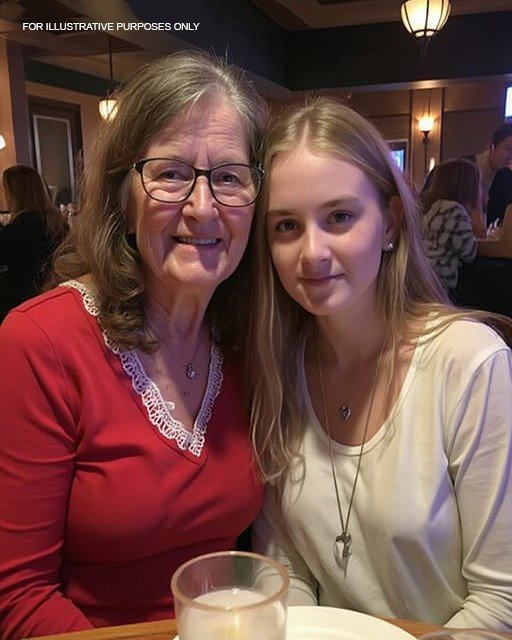
We ordered drinks: white wine for me, sparkling water for her, and glanced at the menus. The conversation started awkwardly, with little splashes of small talk breaking the silence. She asked about my job.
I asked about hers. She mentioned she had just been promoted. I congratulated her.
She inquired about the house, the garden, and whether the sink was still giving me trouble, small, neutral things. We ordered our meals. The waiter left.
The silence thickened again. Finally, Maddy took a breath. “So… I know things have been distant between us.”
My heart rate ticked up.
Here it comes. “I know,” I said softly. “And I’m sorry for any part I played in that.”
She twisted her napkin.
“It wasn’t really you. I was just… dealing with a lot. Especially after Dad passed.”
“I understand,” I whispered.
She looked at me, then really looked. And in that moment, I saw a flicker of vulnerability I hadn’t seen since she was a teenager. “I want to be better,” she said.
“I want us to be better.”
Warmth bloomed in my chest. “I’d like that too.”
She smiled, small but genuine. For the first time in years, I felt a thread reconnect.
The food arrived soon after, and we ate while talking about Victor, our favorite stories, the small quirks he had, and the things we missed most. Maddy teared up once, and I reached across the table, squeezing her hand gently. She squeezed back.
It felt like healing. Until the dessert menus arrived. The waiter set the little leather check holder on the table beside the plates.
Before he could walk away, Maddy cleared her throat. “Actually,” she said, “can we get one more thing? The large celebration cheesecake?
With the sparkler?”
The waiter beamed. “Of course!”
“Celebration?” I asked, surprised. Maddy gave me a bright smile, too bright.
“You’ll see.”
The cheesecake arrived a few minutes later, grand and glittering, a full-on spectacle. Diners turned to look. I felt myself flush at the attention, but Maddy clapped her hands like a delighted child.
“That looks… incredible,” I said. She cut two slices, sliding one toward me. But instead of digging in, she reached into her purse and pulled out a small white envelope.
“This,” she said, placing it in front of me, “is the reason I wanted to meet.”
My throat tightened. An envelope. Is it a letter?
A photo? A card? News?
“Go ahead,” she urged. I opened it. Inside was… a receipt.
A very, very long receipt. I blinked. Twice.
“What is this?”
She beamed. “The total cost of the rehearsal dinner venue I booked today. For my wedding.”
I stared at her, stunned.
“Your… wedding?”
She nodded proudly. “I’m getting married in November. And this,” she tapped the receipt, “is your contribution.”
The words hit me like a physical blow.
“My contribution?” I repeated slowly. “Yeah.” She spoke casually, as if discussing the weather. “Dad always said he’d help pay for my wedding.
I know he’s gone, but you’re still family. So you’ll help cover the rehearsal dinner costs. This is your portion.”
My hands went cold.
“Maddy… this is over four thousand dollars.”
“I know,” she said breezily. “But that restaurant is perfect for the theme, and they required a deposit today. So I paid it, and you can just transfer your part to me tonight.
Or tomorrow morning at the latest.”
She took a bite of cheesecake, smiling at another diner who glanced our way. I stared at her, speechless. She’d invited me here… not to reconnect.
Not to heal. Not to talk about her father. But to present me with a bill.
A bill she had already decided I would pay. “Maddy,” I said quietly, “I can’t pay this.”
Her smile vanished. “Why not?”
“Because,” I said, struggling to keep my voice steady, “I wasn’t consulted.
And your father wanting to help with your wedding doesn’t automatically mean I owe you thousands of dollars.”
Her jaw tightened. “So you’re refusing?”
“I’m saying it’s not reasonable.”
Her voice rose. “You’re unbelievable.”
A few diners looked over.
I swallowed. “You invited me here,” I whispered, “under the impression that this dinner was about us. About reconnecting.
I had no idea you were planning this.”
“It was supposed to be a gesture,” she snapped. “I thought you’d appreciate being included.”
“Being included,” I said softly, “is not the same as being blindsided.”
She shoved the receipt back into her purse angrily. “Forget it.
I should’ve known you’d be selfish.”
The waiter arrived then with the actual restaurant bill for our meal. He set it gently between us, oblivious to the tension. Maddy pushed it toward me.
“At least you can pay for dinner.”
Something inside me broke not with anger, but with clarity. “No,” I said quietly. Her head shot up.
“What?”
“I won’t pay for the dinner,” I said, keeping my voice calm. “You invited me. And you said it was your treat.”
She blinked, confused.
“But—”
“I’m holding you to your word,” I added gently. She stared at me. For a moment, I thought she might argue.
But instead, her expression hardened. She pulled out her card, slapped it onto the bill, and stood abruptly. “Enjoy your evening,” she said bitterly.
“And don’t worry, I won’t ask you for anything ever again.”
She walked out without looking back. I sat there, motionless, the candle flickering between the untouched cheesecake slices. The next few days were quiet.
No calls. No messages. I spent that time replaying the dinner, wondering if I had been too firm or too soft, too accommodating or too rigid.
But no matter how I examined it, the truth remained the same: Maddy had tried to exploit me, manipulating the moment, the memory of her father, and the fragile thread of reconciliation between us. By the fourth day, I received a text. I’m sorry.
Just two words. But enough to make me pause. Then another:
I wasn’t thinking clearly.
I shouldn’t have done that to you. I hesitated before responding. Thank you for saying that, I wrote back.
I care about you, Maddy. I always have. But I can’t be pressured into things like that.
A long pause. Then:
I know. Can we talk?
For real this time? No surprises. This time, I thought more carefully before answering.
Yes. We can talk. She sent the name of a small, modest café, quiet, nothing like the flashy restaurant.
When we met two days later, she was already seated, hands wrapped around a mug of tea, eyes lowered. She looked different. Softer.
Humbled. “I was wrong,” she said before I even sat. “I let stress and pressure twist everything.
I shouldn’t have put that on you. And I shouldn’t have used Dad as part of it.”
My throat tightened, but I said nothing. “I was scared,” she continued.
“Scared of planning a wedding without him. Scared of doing everything alone. And I guess… part of me thought if you helped pay for something, it would feel like he was still involved.”
A tear slid down her cheek.
She didn’t wipe it away. “But that wasn’t fair,” she whispered. “I see that now.”
Slowly, I reached across the table and rested my hand over hers.
“Thank you,” I said softly. “For telling me that.”
She nodded, squeezing my hand. “I still want you at the wedding.
Just as yourself. Not as someone who owes me anything.”
Warmth spread through me. “I’d love to be there.”
And for the first time, she smiled a true, open smile, without hidden agendas or expectations.
Months later, on her wedding day in late autumn, she stood in her lace gown, radiant and trembling with excitement. Before the ceremony began, she approached me privately. “I have something for you,” she said, handing me a small velvet box.
Inside was a delicate silver pin shaped like a blooming branch, simple, elegant, the kind of piece Victor would’ve chosen. “It was Dad’s,” she said. “His mother gave it to him.
I want you to wear it today. He would’ve wanted you to.”
Emotion swelled in my chest, heavy and sweet and painful all at once. “Thank you,” I whispered.
She hugged me, really hugged me, and for the first time since I entered her life, I felt like I belonged. As the ceremony music began and guests took their seats, she leaned in and said quietly, “I’m glad you’re here.”
I smiled. “So am I.”
And as she walked down the aisle, graceful and glowing, I knew something had changed between us, something real, something firm, something finally free of the past.
It didn’t erase our rocky beginning, or the painful dinner, or the months of distance. But it did something better. It allowed us to start again.
Not as a forced family. Not as reluctant relatives. But as two people choosing, little by little, to build something new.
Together.

