


“He was homeless for a while,” she said, sitting down on the couch. “Got mixed up with some rough people. Didn’t want to drag us into it.”
“Why now?” I asked.
She looked at the photo again. “He said he’s dying. Liver failure.
He’s been sleeping on the floor in that old place, afraid to check into a hospital.”
I covered my mouth. “Jesus.”
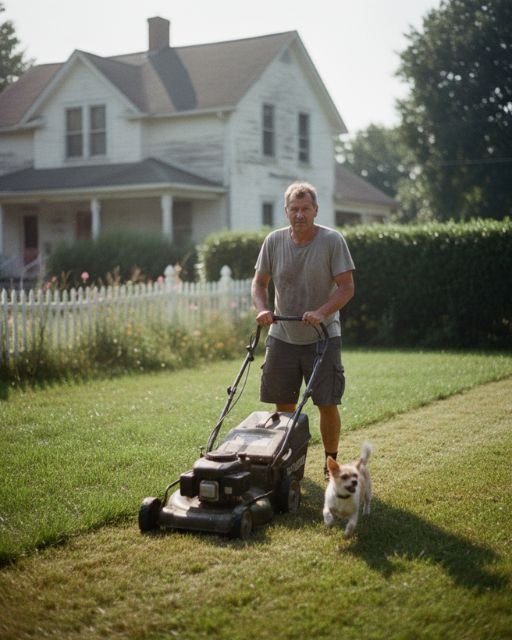
“He just wanted to see us from a distance. Said mowing the lawn gave him peace.
A purpose.”
That hit me harder than I expected. All those Tuesdays, rain or shine. And we never knew.
Mom took a deep breath. “He asked if he could stay here for a bit. Just until he gets things in order.”
Dad nodded slowly.
“Of course.”
So we cleaned out the guest room. He came over with a duffel bag and nothing else. He didn’t speak much, just nodded politely and thanked us.
It was awkward at first. Like living with a ghost you barely knew. But slowly, things shifted.
He started helping around the house. Fixed the fence. Rewired the porch light.
Replanted the herb garden Mom had given up on. He still didn’t talk much, but he smiled more. One afternoon, I found him sitting on the back step with our dog, Lucy, who’d taken a shine to him.
“Thanks for letting me stay,” he said quietly. I nodded. “Thanks for mowing the lawn.”
He chuckled.
“Wasn’t much, but it was something.”
One night, after dinner, Mom brought out a box of old photos. They sat at the table for hours, flipping through memories. Some painful, some sweet.
“I kept this,” she said, pulling out a folded piece of notebook paper. It was a note he’d left the night he ran away. It just said, “Sorry.
Can’t stay.”
He stared at it for a long time. “I was scared,” he said. “Thought if I left, I’d stop being the problem.”
“You were never the problem,” Mom said softly.
The next few weeks felt like a second chance. He started telling stories from when they were kids. About the time they built a treehouse that collapsed the same day.
Or when they snuck into the drive-in behind the high school. I saw Mom laugh in a way I hadn’t in years. But his health was declining fast.
He tried to hide it, but we noticed. The weight loss. The fatigue.
The yellowing in his eyes. We convinced him to go to the hospital. He fought it at first but eventually agreed.
The prognosis wasn’t good. Cirrhosis. Advanced.
Months, maybe less. We brought him home, set up a hospital bed in the living room so he could still watch the squirrels out the window. Neighbors came by.
Some recognized him. One older woman brought a photo of him as a teenager. Said he helped her carry groceries once when her son was sick.
Turns out, he’d done more for the neighborhood than we knew. Fixed mailboxes. Cleared storm drains.
Helped dig out cars during a snowstorm in 2018. All silently. Never asking for thanks.
The Tuesday after he passed, I woke up early. The lawn hadn’t been mowed in weeks, and we’d been too busy to think about it. But there it was—freshly cut.
The same path. Around the rose bush. Back corner untouched.
I ran outside. No one was there. Just the mower, neatly parked by the porch.
And a small note taped to the handle:
“He taught me how.”
It was signed by a local kid named Marcus—maybe 14 or 15. Turns out, my uncle had been showing him how to mow, how to fix small engines, how to stay out of trouble. We gave Marcus the mower and told him he could keep coming if he wanted.
Every Tuesday at 7 sharp, we hear it now. Same route. Same care.
It’s more than grass being trimmed. It’s a reminder that even broken people can leave something beautiful behind. A legacy doesn’t have to be loud to matter.
Sometimes, it’s a quiet act, repeated week after week, by someone trying to make things right. So if you ever see someone doing something kind without explanation—
Maybe don’t question it. Maybe they’re saying “I’m sorry” the only way they know how.
Like this story? Share it with someone who might need to hear it. Sometimes, healing doesn’t look like a conversation.
Sometimes, it looks like a perfectly mowed lawn.