

The letter explained everything, or rather, it raised more questions. Helen wrote that she wanted me and Tyler to join her in Florida for “an important matter.” She promised it would be worth our time and asked me to trust her. My first thought was that this had to be some kind of mistake.
Why would my elderly neighbor, whom I barely knew beyond friendly greetings and that one afternoon mowing her yard, invite me on a private jet trip? I almost threw the whole thing away, thinking maybe it was senility or some bizarre prank. But something in her tone stuck with me; it was urgent, sincere, almost pleading.
Three days later, curiosity got the better of me. Tyler and I arrived at the small private terminal, feeling completely out of place among sleek jets and uniformed pilots. And there she was, Helen, dressed in a smart linen suit, sitting in a wheelchair with her ankle bandaged.
She beamed when she saw us. “Daniel, Tyler, thank you for coming,” she said warmly. “I know this is unusual, but I promise, you’ll understand soon.”
Once we were airborne, she finally told me the truth.
Helen revealed that she and her late husband had built a considerable fortune over the years, much of it invested wisely in land, stocks, and old family trusts. But her children, two daughters and a son, had grown bitter and greedy after their father’s death. They rarely visited her unless they wanted money, and when they did, arguments always followed.
She confided that she was tired of the constant fighting and feared that when she was gone, her estate would tear her family apart even more. “I saw something in you that day, Daniel,” she said, her eyes misting. “You helped me without expecting anything in return.
That kind of kindness is rare. It reminded me of the man my husband was. And I thought… perhaps I could trust you to help me with something important.”
I didn’t know what to say.
Tyler sat quietly, wide-eyed, absorbing every word. Helen explained that she was traveling to Palm Beach to finalize some trust arrangements. She wanted me there because she intended to name me, not her children, as executor of her estate.
The words stunned me. “Mrs. Crawford, I can’t accept that kind of responsibility,” I protested.
“I’m just your neighbor. Your family—”
“My family will fight no matter what,” she interrupted firmly. “But you… You might actually do the right thing.
Please, Daniel. Say yes.”
I sat there, feeling like I’d stumbled into a story that didn’t belong to me. But Helen’s gaze was steady, and something told me this wasn’t just about money or power.
It was about trust, and maybe even a second chance at life for her, and for me. So, reluctantly, I agreed. What followed was a whirlwind.
Over the next few days, I accompanied Helen to meetings with lawyers and bankers. Her children eventually appeared, summoned when they realized their mother was making changes. The tension was palpable.
Her eldest daughter, Margaret, cornered me in the hallway of the law office and spat accusations. “What are you doing here? You think you can worm your way into my mother’s will?
You’re nothing but a handyman neighbor!”
I told her calmly that I didn’t want anything from Helen, but she didn’t believe me. None of them did. Tyler overheard more than he should have: snide comments, threats, whispered arguments, but he surprised me with his maturity.
“Dad,” he said one night in the hotel, “you always told me to do the right thing even when it’s hard. Maybe that’s why she picked you. Don’t quit now.”
The next morning, Helen signed the documents.
I officially became executor, with detailed instructions to manage her estate fairly and ensure a large portion of her wealth was donated to charities she cared about, veterans’ groups, animal shelters, and children’s hospitals. Her children were furious. Voices were raised, lawyers threatened lawsuits, but Helen stood firm.
“It’s done,” she declared. I thought that might be the end of it. But life, once again, had other plans.
Two weeks after we returned home, Helen passed away quietly in her sleep. The news hit me harder than I expected. In such a short time, she had become more than just a neighbor; she was almost like family.
The storm that followed was brutal. Her children filed a lawsuit, accusing me of manipulation and elder fraud. It was ugly, and for a while, I wondered if my life was about to be destroyed because of that one afternoon mowing her lawn.
But Helen had been meticulous. Every document was airtight, every decision clearly explained in her own words and witnessed by professionals. The court upheld her wishes, and though her children walked away bitter and defeated, there was nothing they could do.
In the months that followed, I carried out her instructions. Millions went to charities across the country. Some assets were sold, others placed in long-term trusts.
And to my astonishment, she had left something personal for Tyler and me as well, a modest but life-changing inheritance, enough to pay off my debts, secure Tyler’s education, and give us a stability I hadn’t dared dream of. The first time I opened the letter she’d left for me, I broke down. In it, she wrote: “Daniel, life is unpredictable.
Sometimes it takes a fall in the garden to reveal who truly stands by us. Take this gift, not as a reward, but as a seed. Grow it well, for Tyler’s sake.
And never forget that kindness is the rarest wealth of all.”
I read those words over and over, especially on the hard days when doubt crept in. The feud with her children eventually faded, though I’d occasionally see Margaret drive past my house, glaring with a bitterness that hadn’t softened. But I chose not to dwell on that.
I focused instead on building a better life for my son. Tyler thrived. He joined the school robotics team, something I never could have afforded before.
We took trips together, nothing extravagant, just simple vacations that gave us time and memories. And every time we boarded a plane, whether commercial or the occasional charter arranged through Helen’s estate, I remembered that surreal day when a lawyer had handed me that first private jet ticket. Looking back, it still amazes me how it all began—not with a grand gesture or a calculated move, but with a simple decision to help someone in need.
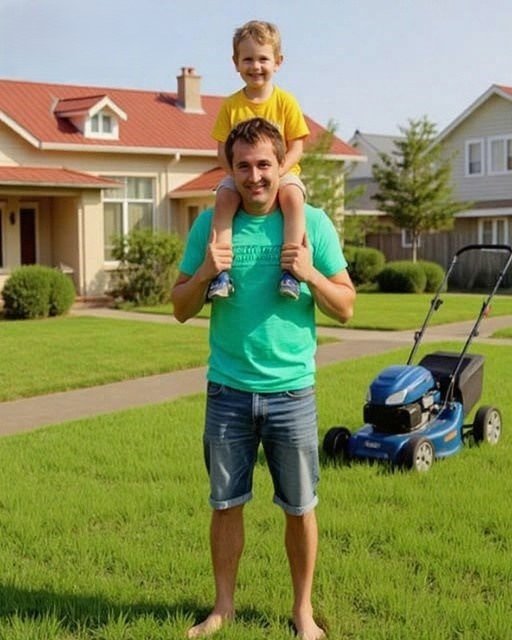
I didn’t mow Helen Crawford’s lawn because I wanted anything in return. I did it because it was the right thing to do. Yet that act set off a chain of events that reshaped our lives forever.
Sometimes I wonder if Helen had been testing me in a way, measuring whether I could shoulder the weight of her final wishes. Other times, I think maybe fate just has a strange sense of humor. Either way, the lesson I carry is this: you never know the true power of kindness until you give it freely.
And so, whenever I push the mower across my own yard now, I pause for a moment and glance toward Helen’s old house. The flag still flutters on its pole, though new owners live there. I like to imagine she’s watching somehow, smiling that same wry smile, knowing her trust wasn’t misplaced.
Because in the end, Helen didn’t just change the course of her family’s fortune, she changed mine and Tyler’s future in ways I’ll never forget.