



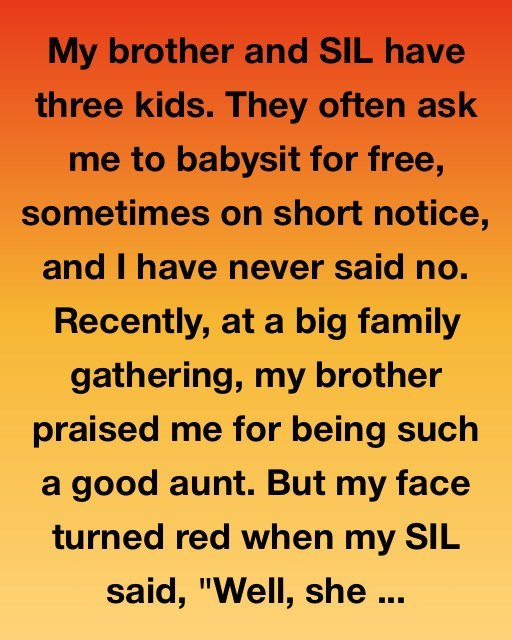
Then my SIL added:
“Yeah, some people like to play the hero until it’s actually inconvenient for them.”
My stomach sank. That was clearly about me. I didn’t reply.
But my cousin privately messaged me and asked, “Was that about you??”
I just sent a shrug emoji. That weekend, I decided I needed some space. I didn’t reach out.
I didn’t offer help. I focused on my own life—caught up on sleep, reconnected with old friends, even started painting again, something I hadn’t done in years. Funny thing is, I felt lighter.
Freer. Then something unexpected happened. About three weeks later, I got a message from my brother.
It was a long one. He said he and his wife were overwhelmed, that things had been hard lately, and that they appreciated everything I’d done. He admitted they’d taken me for granted.
But the part that stuck out was this:
“I think we assumed you’d always be there, no matter what. And that wasn’t fair.”
I didn’t reply right away. I needed time to process it.
Two days later, I bumped into my sister-in-law at the grocery store. She looked… tired. Her eyes had dark circles.
The kids weren’t with her. She came up to me and said, “Hey.”
“Hey.”
She paused, then said, “I’ve been meaning to reach out. I’m sorry about what I said.
At the party… and in the chat. It was petty. You didn’t deserve that.”
I nodded slowly.
“Thanks for saying that.”
She looked down at her cart. “I guess I was just… jealous, in a weird way. You always seem to have it together.
The kids love you. You show up. And I felt like I was being compared without anyone saying it.”
That surprised me.
“I’ve never compared,” I said. “I just wanted to help.”
“I know,” she said. “But sometimes when people help, it feels like a mirror.
And it shows what we’re not doing. Or what we’re too exhausted to do. And I took it the wrong way.”
I stood there, not sure what to say.
She added, “You were right to say no. And honestly, we needed the wake-up call.”
After that, things changed. Not drastically.
But enough. They stopped asking me last minute. When they did ask, they made sure I was free—and always offered to compensate me or at least bring dinner over.
Once, they even booked me a massage as a thank you. I almost cried. But more than that, something changed inside me.
I realized that helping people doesn’t mean losing yourself. That being kind shouldn’t cost your peace. And that sometimes, people only respect your boundaries after you show them.
A few months later, I was at another family gathering. Same crowd. Same setup.
The kids were playing, and my brother stood up to give a toast for Dad’s birthday. In his speech, he turned to me and said, “And I also want to thank my sister. Not just for being the best aunt, but for reminding us what real support looks like.
It’s not just saying yes all the time—it’s loving someone enough to set limits.”
My eyes welled up. That felt more real than any thanks I’d ever gotten before. After the party, my SIL hugged me and said, “We’re lucky to have you.
And we know that now.”
That night, I walked home smiling. Not because I got praise. But because I finally felt seen.
And here’s the thing I learned:
Sometimes people don’t mean to take advantage. They’re just busy. Overwhelmed.
Focused on their own chaos. And you? You become background help.
The safety net. Until one day you step back—and they realize the weight you were carrying all along. If you’re reading this and you’ve ever felt taken for granted, let me tell you: your kindness matters.
But so do you. Setting boundaries doesn’t make you selfish. It makes your kindness sustainable.
Sometimes, saying “no” is the most loving thing you can do—for them and for you. And funny enough, that’s when people finally start to see you. If this story touched you, share it with someone who always shows up—but forgets to show up for themselves.
Like and spread the word. Maybe it’s time they heard this too.