



I live in a townhouse complex where the walls are paper-thin. My neighbors, Diane and her husband, fight constantly. It’s not just yelling; I’ve heard things smash against our shared wall, followed by dead silence.
Their son, Mateo, is about seven. He’s a sweet, shy kid who barely speaks. He also seems to be the clumsiest child on the planet.
At least, that’s what Diane says. “Oh, Mateo’s a typical boy, always falling down!” she’d laugh whenever I’d see him with a new, dark bruise on his arm or a fading black eye. She’d say it a little too loudly, a little too cheerfully.
But Mateo never acted like a “typical boy.” He never ran or shouted or roughhoused at the playground. He mostly just sat by himself, watching the other kids. My stomach was always in knots about it.
Do I call someone and risk being wrong, making things worse for them? Or do I say nothing and live with the thought that I could have helped? Then came the annual summer pool party for our complex.
I was sitting on a lounge chair when I saw Mateo cautiously stepping into the shallow end. Diane was a few feet away, scrolling on her phone, completely ignoring him. He wasn’t running or jumping, just carefully walking.
Suddenly, his feet slipped on the slick pool floor and he went down, hitting his elbow on the concrete edge. He let out a sharp cry of pain. Diane’s head shot up.
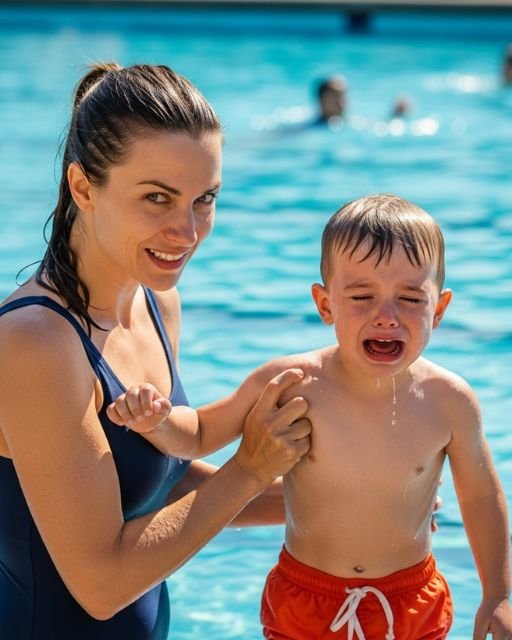
But she didn’t look concerned. She looked furious. She stormed over, yanked him out of the water by his good arm, and got right in his face.
I couldn’t hear everything she hissed at him, but I heard the words “stupid” and “attention.” Then she looked over and saw me watching. She gave me a cold, dead-eyed smile and, loud enough for me to hear, said to Mateo, “See what you made me do?”
Something in me snapped. I stood up, walked straight over, and said as calmly as I could, “He slipped, Diane.
That wasn’t his fault. He’s hurt. Maybe he needs to be looked at.”
She turned on me with that same smile, but her eyes were full of something else—something mean.
“He’s fine. He just likes to play the victim.”
Mateo looked up at me, water dripping from his curls, his lip trembling. I’d never seen a child look so small.
“I can take him to first aid,” I offered. “We’re going home,” she snapped, already dragging him away. The rest of the pool party passed in a blur.
I couldn’t stop thinking about that moment. Her tone. His face.
That weird smile she gave me. And for the first time, I stopped wondering if something was wrong and started accepting that something definitely was. That night, I made a call.
I told the social worker everything I’d seen and heard. I didn’t have physical proof, but I had my observations and my gut. I even sent a few photos I’d taken over the past few months—group pictures from neighborhood events where Mateo’s bruises were visible.
I didn’t know if it would be enough. I didn’t see Diane or her husband for three days after that. But on the fourth, something strange happened.
Mateo knocked on my door. He was alone. I opened the door slowly, worried he’d gotten away from them somehow.
The story doesn’t end here — it continues on the next page.
Tap READ MORE to discover the rest 🔎👇