

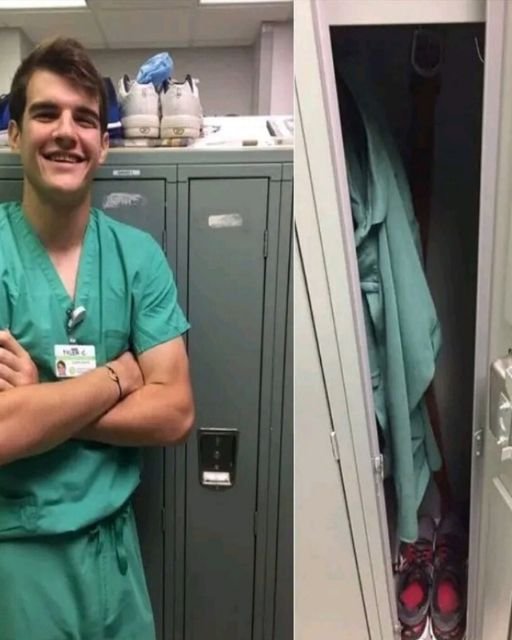
One month after my father passed, I opened his hospital locker for the first time. The smell of antiseptic and his presence lingered. He was an anesthesiologist for 23 years, caring for patients like family.
Despite his diagnosis of stage 4 bile duct cancer, he never lost his purpose. He faced each day with faith and kindness until he passed in 2017. When I began working at the hospital this June, I was given the key to his locker—a powerful passing of the torch.
It’s more than a locker; it’s a daily reminder to treat every patient with compassion. Now, as I prepare for each shift, I carry his legacy with me—not just following his footsteps, but walking them with grace and love. The day I first turned that key, I thought I was ready.
I’d told myself it was just a locker. Just metal and hinges, nothing more. But when the door creaked open, the air inside felt thick.
A small folded lab coat hung neatly on the hook, just the way he always kept it. His name badge, slightly scratched at the edges, rested in the side pocket. A faint scent of his aftershave still clung to the fibers.
Inside were a few things I hadn’t expected—an old leather notebook, a half-used pen, a stack of patient thank-you cards, and a small wooden box. My hands hesitated over that box. It felt heavier than it should, and for a moment, I wondered if I should even open it.
But curiosity and longing got the better of me. Inside, I found an assortment of items that made no logical sense together: a tarnished wristwatch, a set of keys I didn’t recognize, and a folded piece of paper with the words “For when you need it most” written in his handwriting. I couldn’t help but smile through the lump in my throat.
It was so like him to leave something vague and mysterious. I tucked the note back and decided to focus on the notebook. The first pages were filled with medical notes—drug calculations, quick sketches of anatomical diagrams, lists of patients’ allergies.
But as I flipped further, the tone shifted. He’d started writing little reflections about his days—some no longer than a sentence, others spilling over a page. One entry stopped me.
“Some of the greatest surgeries I’ve been part of weren’t about saving lives but about giving someone a little more time to say goodbye. Never forget, medicine is about moments, not just cures.” I had to close the book for a second and take a breath. As weeks went on, I found myself going back to that locker before every shift.
Sometimes I’d just touch the notebook, other times I’d read a random page for guidance. And slowly, something strange started happening. The first time was with a young patient, barely nineteen, who came in for a routine procedure but was shaking uncontrollably from anxiety.
I remembered one of my father’s entries: “Sometimes a joke or a story works better than any sedative.” I found myself telling the patient a silly story about my father’s first day in the hospital when he accidentally sat in a rolling chair that slid halfway across the room. By the time I finished, the kid was laughing—and his heart rate had calmed enough for us to begin. Another day, I was dealing with a difficult family—angry, scared, and demanding answers I didn’t have yet.
The story doesn’t end here — it continues on the next page.
Tap READ MORE to discover the rest 🔎👇