



The town of Harmony Creek was a place you found only by mistake. A forgotten little town nestled in the Appalachian foothills, it had been unceremoniously cut off from the world when the new interstate was built a decade ago, leaving it to slumber in the quiet shadow of the mountains. At the heart of the town was “The Corner Spoon,” a diner that was less a business and more a time capsule.
The red vinyl on the booths was cracked and worn smooth, the chrome trim was dull with age, and the air was permanently saturated with the comforting scent of old coffee, fried onions, and a history of simple, honest meals. Lia, in her late twenties, was the reluctant curator of this museum. She had inherited the diner, and the weight of its legacy, when her father, Daniel, passed away a year ago.
She was a talented cook, with a palate that yearned for the vibrant, complex flavors of a grander culinary world, but she felt trapped here, serving the same pot roast and meatloaf her father had for thirty years. She loved him, but she resented him, too—for the quiet, inexplicable way he had simply given up. She polished the worn formica countertop, her gaze landing on a faded, sepia-toned photograph taped to the back of the cash register.
It was the only picture she had of her father from before Harmony Creek. In it, a young, vibrant Daniel Miller stood in a gleaming, professional kitchen, a chef’s toque perched jauntily on his head. He was smiling, a brilliant, confident expression, and in his hands, he held a thick, leather-bound recipe book.
That same book now sat on a shelf behind the counter, its spine broken, its pages stained and soft with use. It was his bible, and now it was hers. She picked it up, flipping through the familiar recipes.
But in the very center of the book, there was a jagged, ugly scar. Several pages had been crudely torn out, leaving behind only ragged stubs of paper. “Still staring at that old book?” a voice called out.
It was Earl, a farmer who had been eating breakfast at the same counter stool for forty years. Lia sighed, closing the book. “He never talked about the missing pages.
Just said the best parts were gone. After they disappeared, he quit the big city and came back here. Never cooked with the same fire again.”
In the corner of the diner, a small, staticky television was tuned to a daytime talk show.
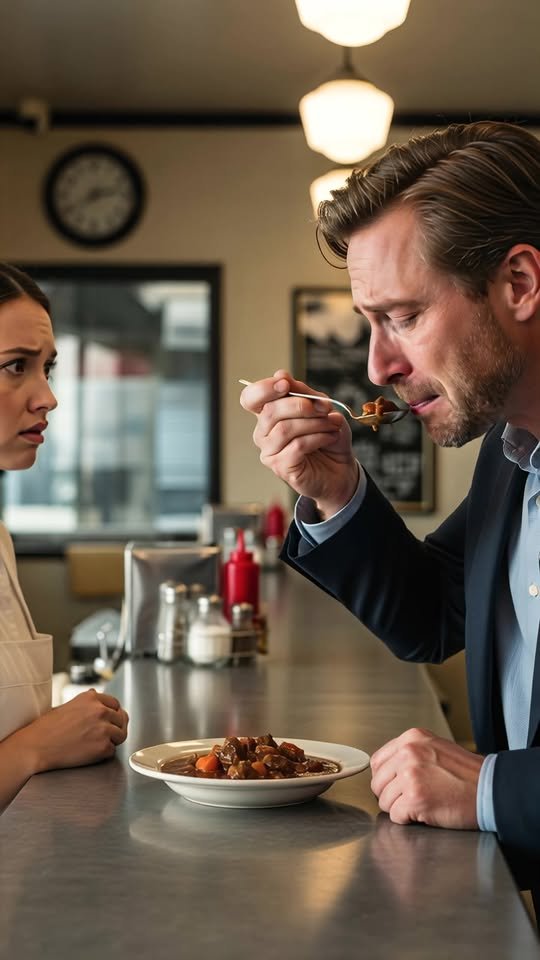
A clip was playing from a popular food documentary, featuring the world’s most feared and revered food critic: Alistair Finch. Known to the culinary world as “The Butcher,” Finch was a man whose words could close a Michelin-starred restaurant overnight. The clip showed him in a lavish, five-star establishment, taking a single, theatrical bite of a dish.
He placed his fork down, his face a mask of cold contempt, and delivered his verdict in a voice that was pure ice. “Originality, chef, is the currency of this craft. Duplication is the confession of a bankrupt soul.
This is soul-crushing mediocrity. A photocopy of a photocopy.”
Lia shuddered. The man was a monster.
The storm that had been threatening all day finally broke with the fury of a betrayed god. Rain came down in blinding, horizontal sheets, and the wind howled through the valley like a mourning animal. The lights in the diner flickered, then held.
The story doesn’t end here — it continues on the next page.
Tap READ MORE to discover the rest 🔎👇