

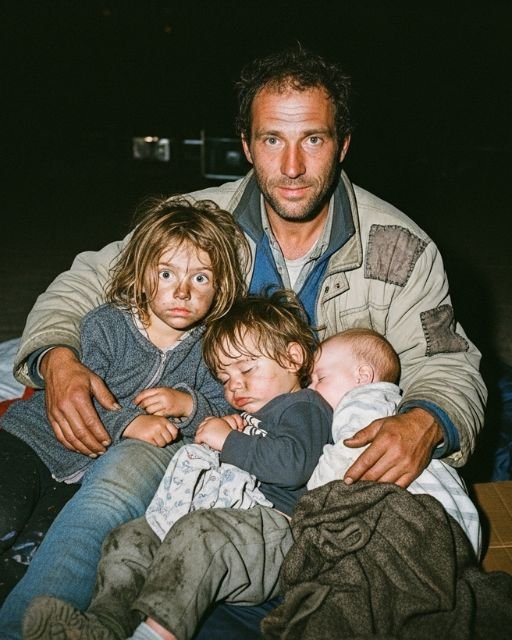
I couldn’t cry in front of him. I didn’t want him to see what he’d broken. Back at the van, the kids were still asleep.
I climbed inside, curled up in the front seat, and stared at the ceiling until the sun started creeping over the horizon. The next few days were rough. I couldn’t stop thinking about Ramon.
Every bite of food I’d accepted from him felt different now. He hadn’t done it out of kindness—he’d done it to make himself feel better. I kept to myself more.
Skipped the free breakfasts at the park where he sometimes showed up. Then, two weeks later, something weird happened. I got a call from a housing office—one I’d applied to months ago and forgotten about.
The woman on the line said someone had advocated for me, sent in a letter of support, and that I’d jumped up the waiting list. “We’ve got a small unit available,” she said. “It’s temporary, but it’s clean and safe.
Would you be able to come in tomorrow and fill out the paperwork?”
I didn’t know what to think. I said yes, of course. Spent the whole night wondering who had done it.
I thought maybe the caseworker from CPS had followed up. But she hadn’t seemed the type. Then I thought about Sister Nina from the food pantry.
But when I showed up to the housing office, there it was—his name, scribbled at the bottom of the support letter: Ramon Velasquez. I stood there holding the paper like it might catch fire in my hands. I hated how confused I felt.
That night, I saw his truck again. I didn’t want to go to him. But I did.
He saw me coming and held up his hands before I even spoke. “Before you say anything—yes, I did it. The letter.
The calls. The follow-up.”
“Why?” I asked. “You thought I was a bad mom two weeks ago.”
“No,” he said firmly.
“I never thought that. But I thought you were stuck. And I didn’t know how to help without making it worse.
So I screwed it up first… and then tried to fix it.”
I shook my head, trying to make sense of it all. “You should’ve just helped. Without the CPS stuff.
Without the betrayal.”
He nodded slowly. “I know. And I’m sorry.
I thought I was doing the right thing. Turns out, I didn’t know what that even looked like.”
I looked at him for a long time. “You hurt us,” I said.
“But… this place? It means something. For the kids, especially.”
He opened the window a little more and passed me a warm paper bag.
“Chicken mole tonight. For the first dinner in your new place?”
I hesitated… then took it. The new unit wasn’t fancy—just two rooms, an old fridge, and a view of the dumpster out back.
But it had locks on the doors. A clean bathroom. A little shelf for the kids’ books.
The first night there, we all slept in the same room, just like in the van. But it felt different. It felt safe.
A few weeks later, I got a job at a thrift store nearby. Nothing glamorous, but steady hours and enough to start building a little savings. Ramon didn’t come around much after that.
Maybe he figured I didn’t want him to. He was mostly right. But one afternoon, he knocked on the door.
He had a little box in his hands. “I won’t stay,” he said quickly. “Just wanted to drop this off.”
It was a plastic container filled with school supplies—pencils, notebooks, markers, even a new backpack for Dani.
“There’s a school up the road,” he said. “They’ve got a program for families like yours. Free lunches, afterschool care.
Thought you might wanna know.”
I thanked him. Then closed the door and cried a little. Not because I forgave him yet.
But because I could see he was trying to learn how to help the right way this time. The kids are doing better now. Dani made a friend named Ellie who lives across the hall.
My youngest, Toby, doesn’t get scared when he hears sirens anymore. And me? I’m learning too.
Learning to ask for help before things fall apart. Learning that sometimes people mess up even when they care. I still don’t know if Ramon did the right thing that night.
But I know he’s the reason we’re not sleeping in that van anymore. And maybe that counts for something. People like to imagine that kindness always looks gentle.
But sometimes it comes wrapped in sharp corners and hard truths. If there’s one thing I’ve learned, it’s this: help that’s wanted is better than help that’s forced. But when you’re falling, and someone reaches for you—even clumsily—you hold on.
Because sometimes, that’s how we climb out. If this story meant something to you, give it a like or a share. You never know who might need to hear it.