



“Tell me about the treatment. How often? How much?”
She sighed.
“Weekly sessions, at least at first. And the cost…”
The number she quoted made my stomach clench. But what choice did I have?
“I’ll figure it out,” I said, though my voice wavered. “Margaret,” she added gently, “there are support groups, assistance programs—”
But I didn’t want support groups. I wanted my son back.
After hanging up, I called my boss at the diner. “Jerry, I need more hours,” I told him. “Margaret, you’re already working six days a week.
Are you sure?”
“I’m sure. Please.”
He sighed. “Alright.
I’ll see what I can do.”
So began the grind that would define my next thirteen years. Up at 5 a.m., at the diner by 6. On my feet until mid-afternoon, then off to my second job at a small office, filing papers and answering phones until late evening.
Home, dinner, bed. Wake. Repeat.
Weekends were reserved for treatments and laundry. No time for friends. No energy for hobbies.
Just work and survival. Daniel’s room remained untouched, as though he might walk through the door at any moment. Time slipped through my fingers like water.
Seasons changed. Wrinkles carved their stories on my face. I paid bill after bill until the debts shrank, though they never quite disappeared.
Dr. Chen became more than just my doctor—she became my confidant. “Margaret,” she said during one appointment, “you’re improving, but the stress is hurting you.
You need to take care of yourself.”
I gave her a weak smile. “I’m doing the best I can.”
“Have you thought about support groups?” she asked again. I shook my head.
“There’s always another shift. Another bill.”
She didn’t push. She knew my stubbornness by now.
Every year, on Daniel’s birthday, I lit a candle in his empty room. Every Christmas, I stared at the phone, wishing it would ring. But it never did.
I tried dating once or twice, but how could I explain my life? My debts, my illness, my son who had abandoned me? I gave up.
Loneliness became my closest companion. Thirteen years later, the unexpected happened. It was a Tuesday evening.
I’d just sat down with a cup of tea when I heard a knock at the door. When I opened it, my breath caught. Daniel stood on the porch.
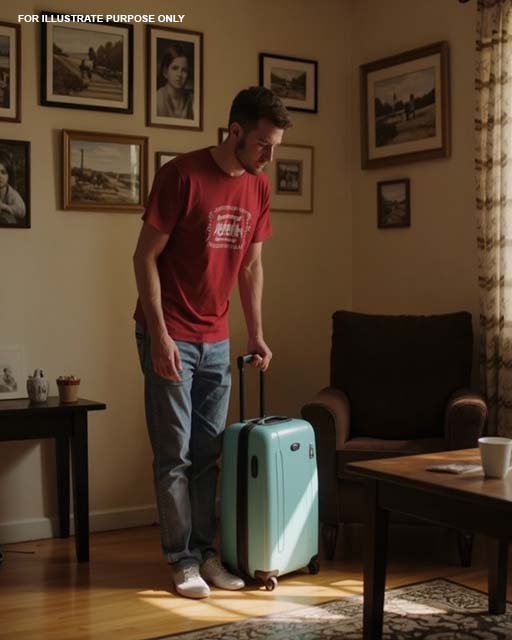
Older now, thirty-one, with broad shoulders and weary eyes. He carried two suitcases and wore a hesitant smile. “Hi, Mom,” he said softly.
“I… I want to come home.”
The world tilted. Part of me wanted to slam the door, to scream at him for abandoning me when I needed him most. But another part—the mother part—ached to pull him into my arms.
Instead, I stepped aside. “Come in.”
We sat in the living room, the silence thick. Finally, Daniel dropped to his knees.
“I’m so sorry, Mom,” he said, his voice breaking. “I had… problems. I didn’t want to drag you down with me.”
I folded my arms, my voice sharp.
“What kind of problems?”
His eyes brimmed with tears. “I got mixed up with bad people. Drugs, gambling.
I was drowning, Mom. Leaving felt like the only way to protect you.”
Anger flared hot in my chest. “You could have told me.
We could have faced it together.”
“I know that now,” he whispered. “I was young and stupid. Can you ever forgive me?”
I sighed, the weight of thirteen years pressing down.
“I don’t know, Daniel. I need time. But you can stay—for now.”
That night, we ate dinner together.
The clink of forks was the only sound. He looked different, older, but still my son. “So,” I asked cautiously, “what have you been doing all these years?”
He pushed food around his plate.
“It’s a long story. I’ve been all over. Trying to sort myself out.”
“And have you?” My voice sharpened.
He nodded. “I think so. I’m clean now.
I have a job lined up in the city. But I had to see you first. To apologize.”
I wanted to believe him.
God, I wanted to. Later that night, I showed him to his old room. “I missed you every day, Mom,” he whispered.
I nodded, unable to speak. As I closed my bedroom door, I allowed myself a flicker of hope. Maybe, just maybe, we could rebuild.
But at 2 a.m., I woke to strange noises. I crept down the hall, heart pounding. In the moonlight, I saw him—Daniel—rifling through the closet where I kept my savings.
The money I had scrimped and saved for years. “What are you doing?” My voice was ice. He jumped, spinning around with a wad of cash in his hand.
“Mom! I… I can explain!”
“Get out,” I said flatly. “Get out now, or I’m calling the police.”
His face crumpled, boyish for a moment.
Then it hardened. Without a word, he grabbed his bags and left. The door slammed behind him, and the silence returned.
But this time, it felt different. I sank to the floor, tears streaming. Thirteen years of waiting, hoping, imagining his return—all shattered in one night.
And yet, beneath the grief, I felt something else. Strength. Peace.
I had survived Robert’s death, crushing debt, and a chronic illness. I had survived Daniel’s absence. I could survive this too.
When dawn painted the sky with pale light, I picked up the phone and dialed Dr. Chen’s office. Her answering service picked up, and I left a message.
“Dr. Chen, it’s Margaret. I think I’m ready for that support group you mentioned.
And maybe… a therapist, too. Please call me back.”
For the first time in years, I wasn’t waiting for my son to return. I was choosing myself.
And that, I realized, was the beginning of my new life.