

I have always been your mother. I loved you before you were born, through every harsh word, and I love you still. Forgive me.”
It broke him—cleanly, finally.
All the years he’d spent guarding himself from love because love had failed him once, all the hard words he’d used to keep her at a safe distance, came back like echoes. He pressed the letter to his chest and said the word he’d been too proud and too scared to say. “Mom.” He said he was sorry.
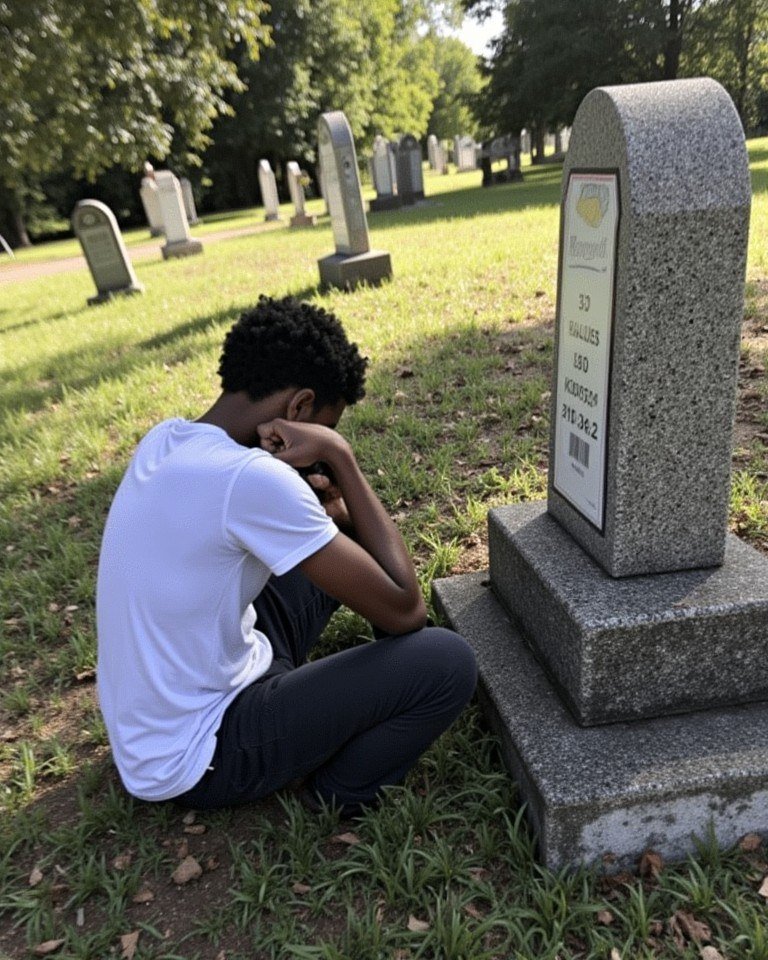
He said he loved her. The wind moved through the trees, indifferent and somehow kind. Grief didn’t evaporate overnight.
It became a daily practice: walking to the cemetery, sitting on the low stone ledge, reading the letter again, talking out loud. He told her about school, about the math teacher who misunderstood him and the classmate who didn’t. He told her he’d found the notebook and that the laundry instructions actually worked.
He told her the casserole he burned had set off the smoke alarm and that he’d laughed, alone in the kitchen, because he could hear her voice telling him to crack a window. He brought white lilies when he could afford them and dandelions when he couldn’t. In the house, the silence thinned.
He noticed what she’d left—small, practical acts of care in every room. The teddy bear she’d stitched when a seam split. The way she’d labeled drawers so he’d never have to ask and feel foolish.
The photo frame on his wall he’d never really looked at: the two of them on a park bench when he was six, his head on her shoulder, mid-scowl, her mouth tilted into a smile that said she knew the scowl was a costume and loved the boy underneath it anyway. He also found her diary, tucked in the back of a closet in a shoebox of winter scarves. Inside the cover, in her neat hand, a line he’d once thrown away as sentiment: “Always & forever, Mom.” Now it felt like an anchor.
He copied the words on a sticky note and stuck it to the bathroom mirror. He read the diary slowly, not to chase the past but to understand it. There were no secrets beyond the one she had already told him, only pages of ordinary love: grocery lists, reminders to buy his favorite cereal, notes about saving for a bike, worries about a cough he’d had for too long.
He realized how often love is paperwork and casseroles and rides to school, how unglamorous and unshakable it can be. The letter didn’t rewrite their history; it reframed it. His cruelty hadn’t bounced off her—it had landed, and she’d borne it because she knew where it came from.
He didn’t forgive himself all at once. He started with small things: saying her name out loud, thanking her when the washing machine finished a load and he remembered the recipe for towels she’d written; choosing to answer when Carol called to check in; deciding to pass math because he owed that to the woman who sat through a hundred battles over homework and never once surrendered him to his worst story about himself. On the forty-ninth day, he brought a second envelope to the grave.
It held a single page: what he wished he’d said while she was alive. He read it once and left it under the vase, tucked where only he and she would know. “I was wrong,” it said.
“You were my real mother the whole time. You chose me twice. I choose you every day.”
He walked home lighter.
The house was still quiet, but it no longer felt empty. He put the teddy bear on the pillow, opened the notebook to the page on roasting chicken, and followed her steps line by line. When the timer dinged, he set a plate for one and said grace the way she used to—short, grounded, grateful.
Then he ate, and for the first time in a long time, the food tasted like something other than survival. He kept visiting, not out of guilt but out of habit, the good kind. He brought news, setbacks, small victories.
He started saving for a bike because she had. He learned that love can arrive late and still be on time. And he learned the simplest truth written between every line of her letter: some bonds aren’t made by blood or paperwork alone; they’re made by the stubborn act of showing up, again and again, until a frightened heart finally believes it is safe.