


He paused behind the corner, steadying his breath. “Don’t panic,” he whispered to himself. “Just see what’s going on.”
He peeked around and saw two men standing near a young woman.
She looked frightened, her hands clenched at her sides. The men appeared to be arguing, one holding a phone, the other pacing impatiently. Then, in a split second, her eyes lifted — and met his.
Something in her gaze stopped him cold. Fear. Helplessness.
A silent plea for help. It was enough. Stepping Forward
Hammer had faced danger before — but never like this.
Not because of what he saw, but because of what it represented. He knew the easy thing to do was walk away, pretend he hadn’t noticed. But something deep within him — that old soldier’s instinct to protect — wouldn’t let him.
He straightened his jacket, took a deep breath, and walked into the open. “Everything alright out here?” he asked, his voice even, calm, casual. The men turned, startled.
One of them gave a forced laugh. “Yeah, all good, old man. Just talking.”
Hammer nodded, pretending to believe it, but his eyes stayed on the young woman.
“Alright then,” he said slowly, “I just saw the light back here and didn’t want anyone to get locked out.”
The taller man’s impatience was clear. “We’re fine,” he snapped. Hammer didn’t move.
He reached into his jacket slowly — not for a weapon, but for his wallet. “If you folks are stuck or short on gas money, I can help out,” he said lightly. “Been stranded before.
Not fun.”
The men exchanged glances, unsure what to make of him. Then, seizing the brief silence, Hammer looked at the girl. “Miss, are you alright?” he asked softly.
Her voice came out trembling but clear enough to change everything. “Please…”
That was all he needed. A Moment of Courage
In an instant, the tone shifted.
Hammer’s calm expression hardened into something else — quiet authority, the kind that came from decades of discipline and conviction. “I think this conversation’s over,” he said firmly. The two men froze.
There was something about his voice — steady, unyielding, certain — that made them hesitate. The taller one took a half step forward, but Hammer didn’t flinch. His stance alone said enough: You don’t want to do this.
A long silence hung in the air before the men turned away, muttering under their breath. Moments later, the sound of a car engine echoed across the lot, fading into the distance. Hammer exhaled, his pulse finally slowing.
He turned to the young woman, whose shoulders were trembling. “You’re safe now,” he said gently. “Let’s get you inside.”
Finding Safety
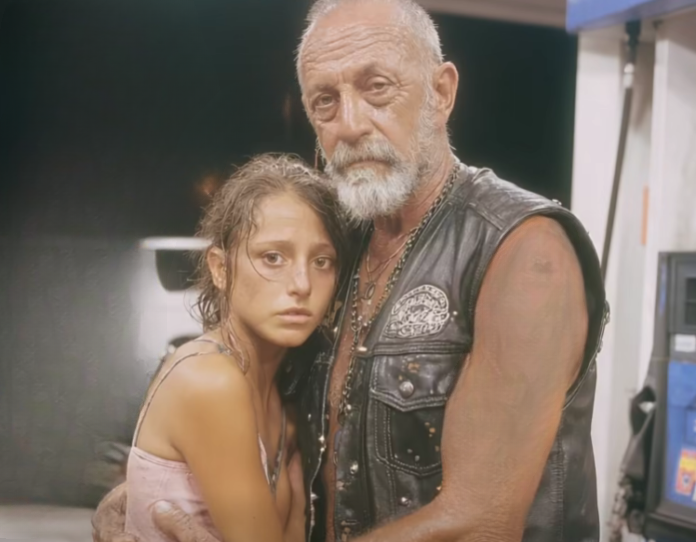
Inside the gas station, the sleepy attendant’s eyes widened at the sight of them.
Without needing much explanation, he grabbed the phone and called for help. Within minutes, police and emergency responders arrived. They spoke calmly with the girl, offering her a blanket and some water.
Hammer stayed close, his presence steady but quiet. He didn’t ask what had happened. He knew sometimes, the last thing a person needs is another interrogation.
When one of the officers asked for her name, she hesitated before answering softly: “Macy.”
Her voice was hoarse but steady, the sound of someone slowly reclaiming control. Hammer gave her a reassuring nod. “You’re doing fine,” he said quietly.
The officer thanked him for stepping in. “Not everyone would’ve noticed,” he remarked. Hammer gave a small shrug.
“Sometimes all it takes is listening,” he said. A Bridge Between Strangers
Over the next few weeks, Hammer found himself thinking about Macy often. He didn’t know much about her situation, only that she had been taken somewhere safe.
Then, one afternoon, he received a call from a local outreach coordinator. Macy wanted to see him. When they met, she looked different — still fragile, but with a spark of strength in her eyes.
“I just wanted to thank you,” she said. “You didn’t know me, but you cared enough to stop.”
Hammer smiled. “You don’t need to thank me.
You did the hard part — surviving.”
That meeting marked the beginning of an unexpected friendship. He began visiting the community center where Macy was staying. Sometimes he brought sandwiches, sometimes old motorcycle magazines, sometimes just quiet company.
She learned that he had served in the Navy, that he had once ridden across the country after returning from deployment, that he believed the road had a way of healing people. And slowly, Macy started to believe it too. Rebuilding Trust
Healing wasn’t easy.
Macy had endured experiences that left deep scars. But Hammer’s steady presence reminded her that kindness didn’t always come with conditions. He helped her find local resources — therapy, job training, education programs — and encouraged her to set small goals.
“You don’t have to fix everything at once,” he told her. “Just one mile at a time.”
Weeks turned into months, and Macy began to rediscover who she was. She took art classes at a local community college, volunteered at the center, and even started speaking to others who were going through difficult times.
When she painted, she said it felt like breathing again. Hammer watched her transformation with pride. He’d seen courage on battlefields, but what she was doing — facing fear and choosing to rebuild — was something even greater.
Learning to Ride
One evening, as they sat outside the community center watching the sunset, Macy surprised him. “Will you teach me to ride?” she asked. Hammer chuckled.
“A motorcycle?”
She nodded, smiling for the first time in a while. “You said once that the road can heal. I want to see if that’s true.”
So, he agreed — but not without rules.
“You’ll learn the right way. Safety first, always. Freedom’s worth nothing without responsibility.”
They started with the basics — balance, throttle control, braking, awareness.
Every lesson became a metaphor for life. “When the road gets rough,” he told her, “don’t fight the wind. Lean into it.”
Months later, she rode her first solo lap around an empty parking lot.
Hammer watched, beaming. She wasn’t the frightened girl from that night anymore. She was a survivor, a rider, a woman reclaiming her story.
A New Purpose
As time went on, Macy began using her experiences to help others. She started volunteering at advocacy groups, offering guidance to young people who had lost their sense of direction. She told her story not to gain sympathy, but to show that hope can emerge from hardship.
Her message was always the same: “Compassion can change a life.”
Hammer often attended her talks, always sitting quietly in the back, letting her shine. When people asked how she found the courage to speak publicly, she would smile and say, “Because someone else had the courage to care.”
Together, they began organizing charity motorcycle rides, raising funds for community programs and youth support networks. Riders from across states joined them — not just for the thrill, but for the purpose.
Each ride became a celebration of resilience, of second chances, of humanity at its best. The Road Ahead
Years later, Hammer still rides — slower now, but with the same steady determination. And every so often, when he stops by a gas station at night, he remembers that evening — the quiet cry, the choice to act, the life that changed.
As for Macy, she continues her mission, traveling to schools, shelters, and events to share her message of empathy and strength. She still calls Hammer her mentor — though he insists he’s just an old man who happened to be in the right place at the right time. But the truth is, both of them saved each other that night.
Hammer rediscovered purpose when he thought he’d lost it. Macy found hope when she thought the world had forgotten her. Their story, shared quietly across the riding community, became a testament to the power of simple kindness — a reminder that no act of compassion is ever wasted.
Final Thoughts
Sometimes, the road gives us more than destinations — it gives us meaning. That night on Interstate 70 wasn’t about heroics or luck; it was about choice. A choice to listen when most would tune out.
A choice to care when it would’ve been easier not to. A choice that transformed two ordinary lives into a story of extraordinary grace. In the end, the midnight ride that began in sorrow became a journey toward hope — proof that even in life’s darkest hours, light can still find its way through.