


“This should cover it.”
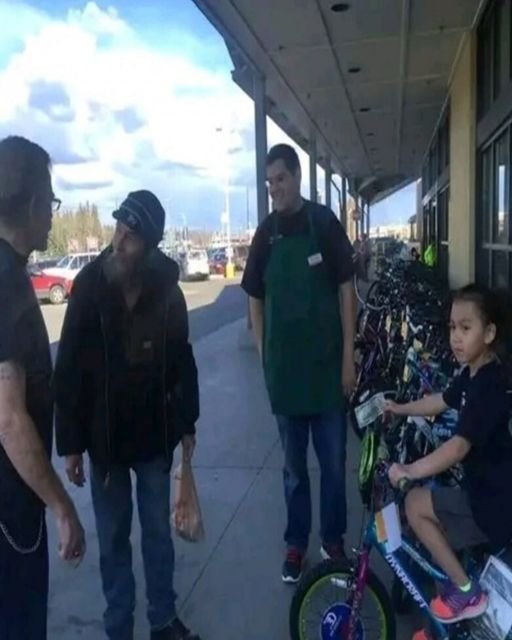
I froze. “Sir, I can’t take your money,” I said, my hands instinctively pushing back. “I insist,” he said softly.
“I never had a bike when I was a kid. My family couldn’t afford it. I used to watch other children riding and imagine what it felt like.
Seeing your little girl with one… it would make me happy.”
Something in his tone told me this wasn’t just politeness. This was a memory that had stayed with him for decades, a quiet ache that never left. I tried to argue again, but he shook his head.
“I don’t have much. No job right now, no home. But I know what it’s like to want something so badly as a kid and not have it.
Please, let me do this.”
It’s hard to explain what I felt in that moment. Gratitude, yes, but also a strange discomfort. Accepting help from someone who had less than you wasn’t easy.
But there was sincerity in his eyes that made it impossible to say no without insulting the gift he was trying to give. Andi looked at me, her eyes wide with a mix of hope and disbelief. I took the money slowly, thanking him more times than I can count.
The store clerk, who had been pretending not to eavesdrop, smiled warmly as she rang up the bike. When Andi wheeled it out the door, the man gave her a small wave. “Enjoy it,” he said, and then he turned and walked away down the street.
For the next few days, Andi rode that bike everywhere. To school, to the park, even just in circles around our block. Every time I saw her pedaling with that basket bouncing in front, I thought about the man.
I realized I didn’t even know his name. That started to bother me. A week later, I spotted him sitting on a bench near the bus stop.
He was eating from a paper bag, the kind you’d get from a soup kitchen. I sat down beside him, introducing myself properly. “I’m Marla,” I said.
“And my daughter is Andi.”
“I remember,” he said, smiling. “Name’s Walter.”
We talked for a while. Walter told me he used to work construction before an injury forced him to stop.
Without insurance and with medical bills piling up, he lost his apartment. He’d been on the streets for almost two years now, picking up odd jobs where he could. I told him how much his gift had meant to us, how Andi still talked about him like he was some kind of real-life hero.
His eyes softened at that. “Makes me feel human again,” he said quietly. “When you’re out here, people stop seeing you as a person.
They just see the mess you’re in.”
Something in my chest ached at those words. I wanted to help, but I knew handing him money wasn’t always the best or safest choice. Instead, I started bringing him coffee when I passed that corner in the mornings.
Sometimes I’d bring a sandwich or a muffin from the bakery. We’d chat for a few minutes, and then I’d go on with my day. One rainy afternoon, Andi and I were headed home when we saw a commotion outside the convenience store.
Walter was on the ground, holding onto a small grocery bag while another man yelled at him. People stood around watching but not stepping in. I didn’t even think—I ran over.
The man was accusing Walter of stealing something. Walter kept saying the bag was his, that he’d just bought bread and milk with money he’d earned sweeping the back alley for the store owner. I turned to the cashier inside, who confirmed Walter’s story.
The accuser muttered something under his breath and stalked away. Walter tried to laugh it off, but I could see the humiliation in his face. Andi, without saying a word, handed him the bright red keychain she’d been keeping in her pocket—a little bicycle charm I’d given her after she got her new bike.
“For good luck,” she told him. That was the day I decided I couldn’t just keep passing by with coffee. I talked to my boss at the bakery about hiring Walter for small tasks—unloading flour deliveries, cleaning the backroom, odd jobs that didn’t strain his injury.
To my surprise, she agreed. Walter showed up every day, always early, always ready to work. He didn’t complain about the pay or the tasks.
Slowly, he started looking healthier, standing straighter. He found a cheap room to rent with two other men, which meant he could finally sleep without worrying about the weather or his safety. One morning, a few months later, Walter came into the bakery carrying something wrapped in an old newspaper.
“For Andi,” he said. Inside was a small wooden box he’d carved himself. The lid had a delicate engraving of a bicycle.
“So she remembers that her smile gave me a reason to keep going.”
It wasn’t long after that when Red finally came by to apologize again for the bike. He brought a bag of donuts as a peace offering. When I told him the whole story of Walter and the bike, his eyes widened.
“Guess I messed up, but maybe it worked out better than I thought,” he said with a chuckle. Life kept moving. Walter became part of our routine, almost like family.
He’d join us for Sunday dinners sometimes, bringing flowers for the table or telling Andi stories from his construction days. She loved hearing about the skyscrapers he’d helped build, her eyes wide as she imagined him high above the city. One day, Walter pulled me aside.
“I’ve been offered a full-time job,” he said, almost shyly. “A buddy from the old crew heard I was working again and recommended me. It’s not construction—more like maintenance work—but it comes with benefits and steady pay.”
I hugged him, genuinely happy.
“You deserve it,” I said. A few weeks later, on Andi’s birthday, Walter showed up at our door. He wasn’t empty-handed this time.
Outside, leaning against the porch rail, was a second bike—sleek, shiny, and clearly more expensive than anything we would have bought ourselves. “For you,” he told Andi. “So you have one for when you outgrow the red one.
And maybe you can give this old one to another kid who needs it.”
That’s when I realized the real twist in all of this. Walter had come into our lives by giving away something he barely had, and in return, he had been given a chance to rebuild. Andi’s smile that day wasn’t just about the bike.
It was about the full circle of kindness she had witnessed. We ended up donating her old red bike to a local shelter for families in need. A week later, we heard that a little boy there had started riding it to school every day.
Andi beamed when she heard the news. “It’s like Walter’s gift keeps moving,” she said. And she was right.
Kindness moves. It doesn’t just stop with one person—it passes along, changing hands, changing lives. That’s the part people forget.
It’s not about how much you have to give, but the heart you give it with. Looking back, I realize that if Red hadn’t run over that bike, none of this would have happened. We wouldn’t have met Walter.
He might still be sitting on that bench, invisible to most. Andi might not have learned that sometimes the people with the least to spare are the ones who give the most. So now, whenever I see someone doing something kind for a stranger, I think of Walter.
I think of that red cruiser with the wicker basket. And I think of how a broken bike became the start of something so much bigger. Life has a way of surprising us when we least expect it.
Sometimes it’s in the form of a stranger’s generosity. Sometimes it’s in the way that generosity finds its way back to them, multiplied. If there’s one thing this whole journey taught me, it’s that you never know how far a small act of kindness will travel.
You might just change someone’s day. You might just change their life. And maybe, without even realizing it, they’ll change yours too.
If this story touched you, share it with someone you care about. And if you ever have the chance to be someone’s Walter, take it—you never know what chain of kindness you might set in motion.