

“They say from there, it’s straight to prison. Better the street. At least I’m my own boss.”
Mary’s heart clenched.
“That’s not true,” she said gently. “Where you come from doesn’t decide who you’ll be. You do.”
That night, Sam fell asleep on the couch under clean sheets for the first time in months.
Mary watched his peaceful face and realized: her life wasn’t over. The next day, she dragged herself through the divorce hearing. Andrew spat insults, painting her as useless.
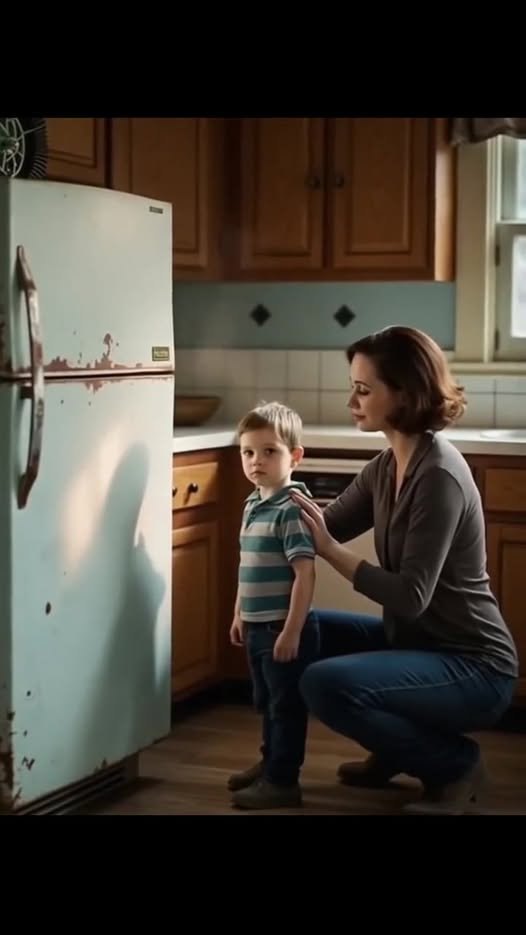
She left the court drained and empty, his mocking words about the refrigerator ringing in her ears. Back in the apartment, Sam was fiddling with the old Frigidaire. “Something’s off with this,” he said, knocking on its side.
One wall sounded hollow, the other thick. Intrigued, Mary pried at a panel inside. To her shock, it came loose, revealing a hidden compartment.
Inside were stacks of dollar bills, velvet boxes with emerald rings, pearls, and diamond earrings. Eleanor, who had lived through the Great Depression, had never trusted banks. She had hidden her savings inside the fridge, knowing Mary would need it one day.
Mary dropped to her knees, tears streaming, as the truth sank in. Her grandmother hadn’t left her with junk. She had left her with a second chance.
Clutching Sam, she whispered, “We’re going to be okay. I can adopt you. We’ll have a home.
A real life.”
The boy’s eyes filled with hope. “You mean it? You’d be my mom?”
“More than anything,” she said.
Years passed. Mary adopted Sam. They used part of the money to buy a bright apartment, and she built a consulting business.
Sam devoured his studies, leaping ahead in school, eventually earning a scholarship to the University of Chicago. Mary rebuilt her life too, slowly finding success and even the courage to love again. Nearly a decade later, Sam stood tall in his graduation gown, valedictorian of his class.
As he walked onto the stage to speak, Mary’s heart swelled. Among the audience sat Andrew, older now but still smug. Sam’s voice was steady.
“Once, I was a homeless boy. But I was found by a woman cast aside by her husband, told she’d end up in dumpsters. Because of that cruelty, she found me—and became my mother.
Today, I thank him. If not for him, I would not be here.”
The crowd gasped, then erupted in applause as Sam looked directly at Andrew. “I will never work for a man who destroys lives.
My success belongs to my mother.”
Andrew’s face burned red as Sam stepped down to thunderous applause. He wrapped Mary in a hug, and together they walked out, heads high. “Mom,” Sam whispered, grinning.
“It’s time you called that professor. You deserve to be happy too.”
Mary smiled through her tears. For the first time in years, she felt it—pure, unconditional happiness.