


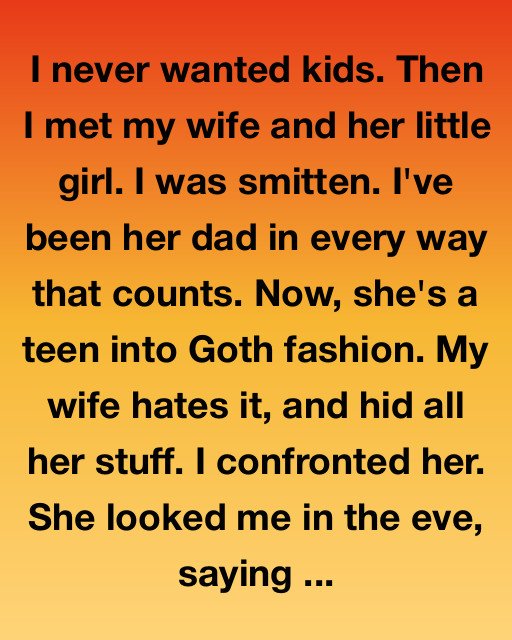
None of us knew. Not even my wife. We all sat on the couch while she read it aloud.
She got in. My wife’s face was unreadable. Mine was a mix of pride and panic.
My baby girl… moving away? “You applied without telling us?” my wife asked. “I didn’t think you’d support me,” she said quietly.
“But Dad always told me to follow what lights me up inside.”
That hit me straight in the chest. I looked at my wife, silently pleading with her to see what I saw—a brave, passionate, beautiful soul chasing her future. That night, after our daughter went to bed, my wife cried.
“I’m not ready,” she said. “She’s still my little girl.”
“She always will be,” I said. “But now she’s becoming who she’s meant to be.”
We helped her move into her dorm that fall.
The car ride was quiet, full of emotions no one knew how to name. At the university, we hauled her things up to her tiny dorm room. Posters, boots, sketchpads, black curtains.
She hugged us both tight. “Thank you,” she whispered into my ear. “For seeing me when no one else did.”
My throat burned as I smiled and said, “Go make some art, kid.”
The drive home was even quieter.
Back in our too-quiet house, things shifted. My wife started flipping through photo albums. She even joined a Facebook group for moms of alternative kids.
One day, she walked into the living room holding a black sweater. “Do you think she’d like this for Christmas?”
I blinked. “You bought that?”
“She’s still our daughter,” she said.
“Even if she looks like she walked out of a vampire movie.”
I grinned. “That’s progress.”
Months passed. Then one night in March, around 1 a.m., my phone rang.
It was her. She was crying. “There was a fire in the art building,” she said, breathless.
“Some students were still inside.”
“Are you okay?” I sat straight up in bed. “I’m fine, I wasn’t there… but my roommate… she was.” Her voice broke. I woke up my wife.
We got dressed and drove through the night. When we got there, she ran into my arms, shaking like a leaf. Her roommate made it out with minor burns.
But the trauma hung in the air like smoke. My daughter barely slept. She started questioning everything.
Her art. Her choices. Her future.
One night, she said, “Maybe Mom was right. Maybe I am just being weird. Maybe none of this is worth it.”
I looked at her and said, “You remember when you were little, and you wanted to paint your room black?”
She nodded slowly.
“Your mom nearly fainted, but I said yes. Not because I love black walls, but because I saw how your eyes lit up just thinking about it.”
“I remember,” she whispered. “You’ve always known who you are.
And the world needs people like that.”
She didn’t say anything, but she curled up next to me on the couch like she used to. And I just held her. Weeks passed.
Spring turned to summer. Her smile slowly came back. Then one afternoon, we got a letter from the university.
She’d been nominated for a national art fellowship. One of five students across the country. She didn’t believe it at first.
I had to read it aloud three times. She flew to New York that fall. My wife and I watched her give a speech at the gallery.
She wore a black velvet dress, her tattoos peeking out from under sheer sleeves. She was radiant. Bold.
Unapologetic. She spoke about identity, pain, fire, healing. About being different.
About being loved anyway. She ended with, “I owe a lot to my parents. Especially my dad.
He stood by me when I didn’t even know I needed someone to.”
People clapped. I cried. On the drive back to the hotel, my wife said quietly, “She’s not the girl I raised.”
“No,” I agreed.
“She’s the woman we helped become.”
The next year, she graduated. She walked across that stage in combat boots under her gown. She waved at us with a smile so wide it made my heart ache.
After the ceremony, she handed me a wrapped gift. Inside was a framed sketch. It was me, sitting on the floor outside her bedroom door, all those years ago.
“You kept this?” I asked, voice cracking. “Of course,” she said. “That night changed everything.”
I looked at her, at the girl who had become a force.
A storm. A lighthouse. “Thank you for letting me be weird,” she said, grinning.
“I never let you,” I replied. “You were weird. I just loved you anyway.”
She laughed.
My wife laughed too. We had dinner that night, just the three of us, and for once, nobody brought up her clothes or her hair or her taste in music. We just talked.
About life. About the future. About love.
Because that’s what it had always been about. She’s now starting her own studio. Teaching young artists how to express themselves without fear.
She says her goal is to make space for kids who feel like outsiders. One day, she showed me a message from a student. It read, “You’re the first person who made me feel like being me was okay.”
She looked up at me and said, “Just like you did for me.”
I don’t know much about fashion.
I still don’t like her music. And I definitely don’t get why anyone would willingly wear black in July. But I do know this:
Sometimes, the best thing you can do as a parent is listen.
Even when you’re scared. Even when it’s hard. Even when you don’t understand.
Because love doesn’t always look like what you expect. Sometimes it wears eyeliner and combat boots. But it’s still love.
And sometimes, if you’re lucky, it grows into something more beautiful than you ever imagined. So yeah, I never wanted kids. But I got the best one anyway.
If this story touched you, share it. Maybe someone out there needs a reminder that being different isn’t wrong—it’s just another way to shine. ❤️