



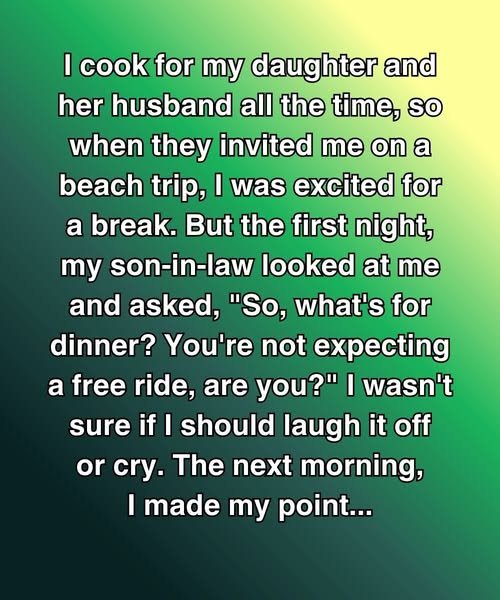
Talia called three times. Then she texted, “Are you okay?” and “Where are you?” and finally, “We didn’t mean it like that.”
I waited a full day before I replied. “I’m okay.
I just needed to rest. Alone.”
That day at the inn, I walked the beach by myself. I got a simple breakfast at a quiet café.
I read in a lounge chair until the sun touched the water. No one asked me for anything. It felt foreign.
Peaceful. Like waking up from a long, exhausting dream. On day two, I got a message from Tarun.
“Hey, sorry about that comment. I was joking. We miss you here.
Talia cried last night.”
I read it twice. He didn’t say I hurt you, just you got upset at my joke. It still rubbed me wrong.
But then, something unexpected happened. I bumped into a woman named Carmel at the inn’s breakfast bar. She was traveling solo too, in her late fifties, with this streak of silver in her hair that made her look like a storm cloud in the best way.
We ended up walking the beach together, sharing stories. She told me about her grown sons—one in Seattle, the other in Dubai. She said she used to break her back to fly across the world to help with grandkids and house chores.
One day, she just… stopped. “They got used to me saying yes. I got used to saying it.
And one morning I woke up and thought—who’s raising me?”
It was like she cracked open a door in my brain. Talia didn’t grow up selfish. She was raised with love and warmth and dinners where we all helped clean.
But after her dad died, I overcompensated. I stepped in everywhere—cooked more, did more, never asked for anything. I thought I was being a good mother.
Maybe I was just erasing myself bit by bit. By day three, I finally answered Talia’s call. She was crying before I even said hello.
“Ma, I’m so sorry. He was being a jerk. I should’ve said something.
I just… I took you for granted.”
That’s when I cried too. We met for lunch later that day. Just the two of us.
She hugged me so tight, I felt like a mom again, not a maid. “I was so mad at him,” she said, picking at her salad. “And at myself.
It’s like… I forgot you were a person.”
That night, Tarun came by the inn to apologize in person. He brought me a small bouquet, awkwardly wrapped in brown paper. I could tell he wasn’t used to saying sorry.
“I messed up,” he said. “It was a dumb thing to say. You’ve done more for us than I ever acknowledged.
I’ll do better.”
I looked him in the eye. “Good. Because next time, I won’t write a note—I’ll book a flight.”
He laughed nervously, but I meant it.
We returned to the rental house together. But things were different now. Talia made dinner that night—pasta with overcooked garlic bread.
It was imperfect and lovely. The next morning, Tarun made coffee and brought me a mug without being asked. Small shifts.
But they mattered. Back home, things continued to change. I stopped being their full-time chef.
Talia came by my house with groceries and said, “Teach me to make that lamb stew.” Tarun bought me a gift card to a spa and said, “Use this alone. Seriously.”
I started volunteering at a local community kitchen. Made friends.
Took a painting class, just because I could. I wasn’t just someone’s mom anymore. I was Rina again.
And here’s the twist I didn’t see coming: two months later, Tarun’s mother came to visit from India. She’s more traditional, and I thought for sure she’d side with her son. But on her second night, over chai, she leaned toward me and said, “Thank you for showing him.
Men like him need reminding. You did the right thing.”
I stared at her. She winked.
Moral of the story? Love doesn’t mean servitude. Being needed is not the same as being valued.
And sometimes, stepping away is the loudest way to say enough. If someone treats your care like it’s owed, not earned, walk. Let them feel your absence like a missing limb.
If they truly love you, they’ll learn how to stand on their own—and maybe even start walking toward you for a change. Hit like if this reminded you of someone—and share it with a friend who gives too much and gets too little.