


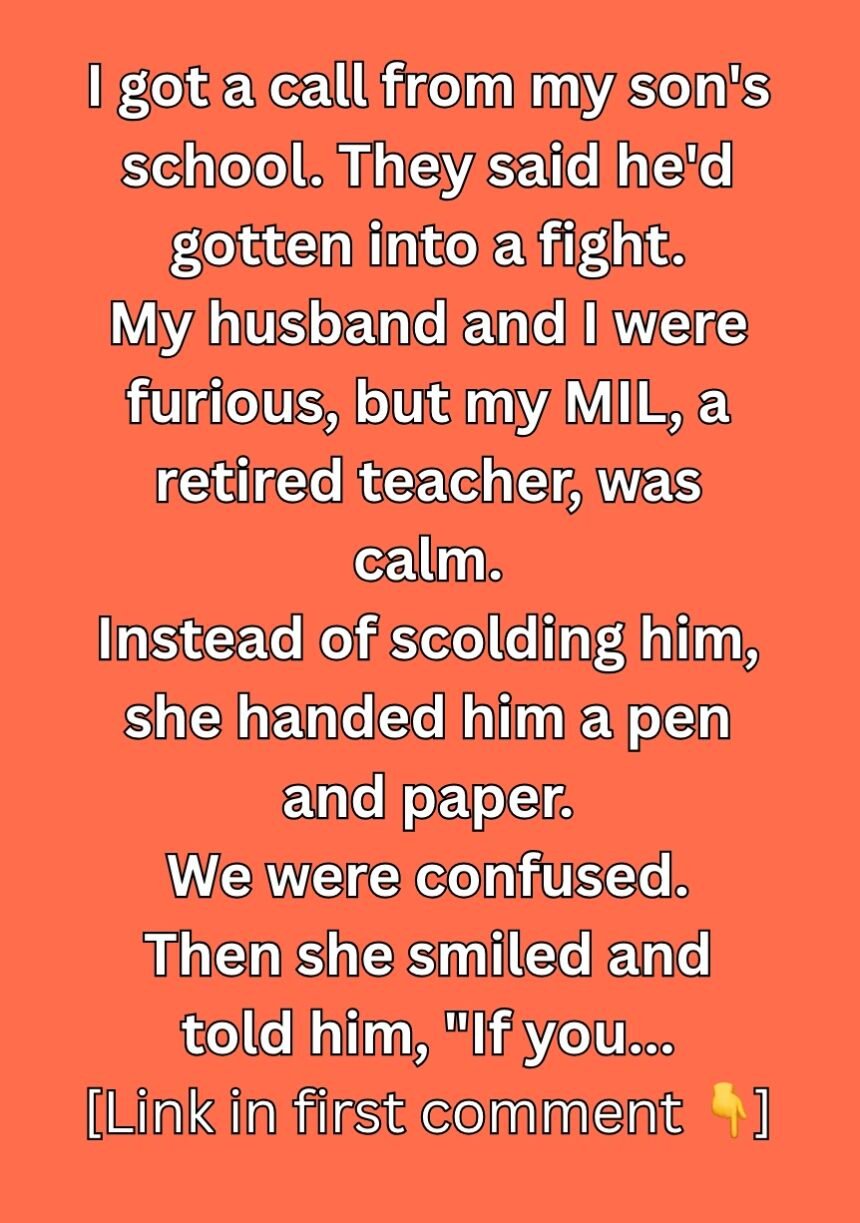
It wasn’t about a boy who had lost his temper for no reason. It was about a boy who had been teased — not once, not twice, but for weeks. It was about name-calling and mockery, about feeling powerless and humiliated.
It was about a kid who had tried to ignore it, tried to walk away, but eventually reached a point where words weren’t enough — or at least, that’s what he thought. His writing was raw. There was anger, yes, but also pain and confusion.
And somewhere beneath it all, there was remorse. I looked up from the paper and met my husband’s eyes. The anger we had been holding onto melted away.
We had been ready to punish him, to lecture him about fighting, without even knowing the whole story. But now, we saw a deeper truth. He wasn’t just a kid who had thrown a punch.
He was a kid who felt cornered, unheard, and unsure of how else to respond. My mother-in-law read the pages too. Then, without a word, she handed him a second sheet of paper.
“Now,” she said gently, “I want you to write what you wish you had done instead.”
This time, there was no hesitation. He picked up the pen and started writing right away. The second letter was completely different from the first.
Gone were the feelings of helplessness and anger. Instead, there were words filled with thoughtfulness, empathy, and even regret. He wrote about walking away.
About telling a teacher. About speaking up instead of lashing out. He even wrote an apology — not just to the other boy, but to himself, for letting his frustration take control.
By the time he finished, something had changed in him. The boy who had walked through the door heavy with guilt was now sitting a little taller, breathing a little easier. He wasn’t proud of the fight, but he was proud of how he had handled this moment.
That night, we didn’t punish him. We didn’t ground him or take away his privileges. Instead, we talked.
We listened. We helped him think about how to handle situations like this differently in the future. And for the first time, he really listened too.
The next day, he asked if he could speak to the other boy and to his teacher. He wanted to read what he had written. When he stood in front of them, holding those pages, I could see the nervousness in his hands.
But as he read his words aloud — his apology, his understanding, his promise to do better — something shifted again. The other boy listened. The teacher listened.
And when he was done, there was no punishment, no resentment, no lingering hostility. There was forgiveness. A few days later, the school counselor called us.
She told us that in all her years working with students, she had rarely seen such a mature resolution to a conflict. Most kids fight, get punished, and move on without ever really learning why it happened or how to prevent it again. But our son had faced it head-on.
He had taken responsibility, reflected deeply, and made amends. It was one of the proudest moments of my life — not because he was perfect, but because he had grown. That evening, after the dust had settled and life had gone back to normal, I sat with my mother-in-law on the porch and thanked her.
“If it had been just us,” I admitted, “we probably would have shouted, punished him, maybe even made things worse.”
She smiled, sipping her tea. “Anger teaches fear,” she said quietly. “Reflection teaches understanding.
And understanding builds character.”
Those words have stayed with me ever since. I realized that as parents, it’s easy to fall into the trap of thinking discipline is about control — about making sure our kids know what they did wrong and that it has consequences. But true discipline, the kind that shapes a child’s heart and mind, isn’t about punishment.
It’s about guiding them to understand themselves and the world around them. Writing became a powerful tool for our son after that day. Whenever he felt overwhelmed — whether by anger, sadness, or confusion — we encouraged him to write it down first.
Over time, he didn’t need prompting anymore. He started keeping a small journal where he would pour out his thoughts. Sometimes he shared them with us, sometimes he didn’t.
But it was his way of processing the messy, complicated emotions that come with growing up. And the boy who once threw a punch? He grew into someone who speaks up.
He learned that words — his words — have power. They can hurt, but they can also heal. They can break down walls or build bridges.
They can express anger or offer peace. I won’t pretend that we never disagreed again or that there were no more difficult moments. Parenting doesn’t work like that.
But that incident changed how we approached those moments. Instead of rushing to anger, we learned to pause. To ask questions.
To invite reflection. And more often than not, the result was understanding — on both sides. It also changed the way I saw my mother-in-law.
Before that day, I had always known she was wise, but I hadn’t fully appreciated just how much she understood about children — not just their behavior, but their hearts. She knew that beneath every outburst was a story waiting to be told. All she did was create space for that story to be written.
And in doing so, she taught all of us a lesson that goes far beyond childhood conflicts. Because the truth is, adults aren’t so different. We lash out when we feel misunderstood.
We shut down when we feel cornered. We make mistakes when we don’t know how else to express ourselves. Maybe we could all benefit from sitting down with a blank sheet of paper and writing our stories too.
That day started with a phone call that filled me with anger and disappointment. But it ended with one of the most valuable lessons I’ve ever learned as a parent: that words, when used wisely, are far more powerful than fists — or punishments. They don’t just explain.
They heal. They don’t just correct. They guide.
And they don’t just resolve conflicts. They build character. It’s a lesson that has shaped not just my son’s life, but our entire family’s approach to communication and growth.
And it all began with a calm voice, a pen, and a blank piece of paper.