

Instead, she swallowed hard and nodded. “Thank you,” she whispered. She squeezed her son’s hand, then looked back at me.
“Thank you so much.”
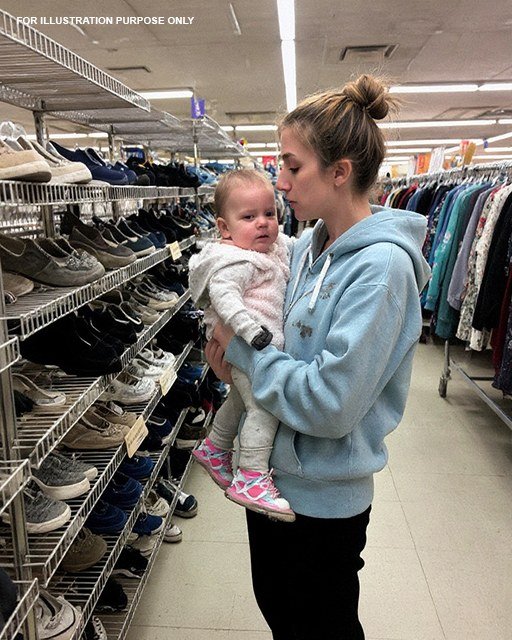
The boy whispered something too quiet to catch, but he hugged the bag to his chest like it contained treasure. I smiled, nodded, and left the shop without waiting for more conversation. Honestly, I felt a little embarrassed.
It wasn’t some grand gesture; it was just fifteen dollars. Shoes. That’s all.
Two weeks passed, and the memory faded into the background of my daily life. I went to work, paid bills, complained about traffic, and forgot about the woman and her son. Then, one evening after dinner, there was a knock on my door.
I wasn’t expecting anyone. When I opened it, I blinked in surprise. There she was.
The same woman from the thrift shop. But she looked… different. Her hair was neatly brushed and tied back, her sweatshirt replaced with a clean blouse tucked into slacks.
She still looked tired, but in a different way, like someone who had finally rested after a long stretch. Beside her stood her son, holding a small box wrapped in paper that had clearly been reused. “Hi,” she said softly, almost shyly.
“I hope this isn’t strange. I had to come find you. The cashier at the thrift store told me where you live—I hope that’s okay.”
I should have been unsettled, but something about her earnestness put me at ease.
“Of course. Please, come in.”
They stepped into my living room, and the boy looked around curiously, still clutching the box. She took a breath.
“You probably don’t realize what that day meant. The shoes. It wasn’t just about sneakers.” She hesitated, and I could see she was trying to find the right words.
“I had just left… a bad situation. My husband, ex-husband now, was controlling and cruel. We finally got out, but I had nothing.
I was staying in a shelter, trying to stretch every dollar, trying to make my son feel safe. That day at the shop, I was looking for something, anything, that could make him smile.”
She glanced down at her son. “And you gave that to us.
You didn’t know, but you gave us hope.”
My throat tightened unexpectedly. I gestured for them to sit, though my living room suddenly felt too small, too ordinary for a moment like this. She continued.
“After that day, something shifted in me. It wasn’t just about the shoes. It was realizing that there are still good people.
That maybe I wasn’t as alone as I thought. I found a job a week later, just part-time cleaning offices, but it’s something. And we moved out of the shelter into a small apartment.
It’s not much, but it’s ours.”
Her voice cracked on the last word. She pressed her lips together, then nudged her son gently. He stepped forward and held out the box.
“For you,” he said shyly. I took it, unwrapping the paper carefully. Inside was a small potted plant, a succulent in a plain ceramic pot.
There was a little card tucked under the leaves, written in uneven handwriting: Thank you for my shoes. Love, Caleb. I swallowed hard, unable to find words.
It wasn’t the plant that moved me—it was the thought, the effort, the fact that they wanted to give back when they had so little. “Thank you,” I said finally, my voice thick. “This means more than you know.”
She smiled faintly.
“No. Thank you. You reminded me I could keep going.”
We talked for a while after that.
She told me her name was Sarah, and her son was indeed named Caleb. She spoke about the shelter, about the fear of starting over, about how something as small as kindness from a stranger could tip the balance between despair and hope. When they left that evening, I stood at the door long after they had gone, staring at the little plant on my coffee table.
I had thought fifteen dollars was nothing. But it had been everything to someone else. Over the next months, Sarah and Caleb became part of my life in ways I hadn’t expected.
Sometimes they would stop by for dinner. Sometimes Caleb would run up with a crayon drawing he’d made, grinning ear to ear. Sometimes Sarah and I would sit over coffee and talk about everything from jobs to books to the frustrations of everyday life.
And one day, months later, as I watched Caleb running through the park in those same white sneakers, now scuffed and dirt-streaked from play, I realized something. That little act of kindness hadn’t just changed their lives. It had changed mine, too.
Because kindness, no matter how small, has a way of echoing far beyond what we can see. And sometimes, fifteen dollars is priceless.