


“I made a mistake,” he said, his voice barely audible. “It was only once. I swear to you, it meant nothing.
It was a stupid, stupid thing.”
I stood there, unable to speak. The walls seemed to close in around me. He went on about stress, about loneliness, about how it had “just happened.” Each word was another crack in something I had thought was unbreakable.
“Did you ever think about me?” I asked quietly. “About your daughter?”
He looked at me, guilt clouding his face. “I didn’t want to hurt you.”
“But you did.”
That night, he slept in the guest room.
I lay awake, listening to the sound of the clock, to the sound of my heart refusing to calm. I had always believed betrayal came with shouting and tears, but instead it came with stillness. In the morning, I packed a bag for myself and Hazel.
I left him a note that said, “I need time to think.” Then I drove to my sister’s flat on the other side of the city. The days that followed were a blur. My sister Anna took care of us quietly.
She made tea, kept me company, and never once said, “I told you so.” At night, after Hazel fell asleep, I sat on the balcony and thought about the life I thought I had, and the one that was now gone. Thomas called every day. He left messages filled with apologies, promises of therapy, declarations of love.
I didn’t answer. I needed to breathe without his shadow. Two weeks later, he came to see me in person.
He looked older, smaller somehow. “It’s over with her,” he said. “Please, I can fix this.
I’ll do anything.”
I looked at him and realized that forgiveness was not the same as forgetting. The love was still there, but it had changed shape—something broken, fragile, unfamiliar. “Thomas,” I said, “you made your choice.
Now I have to make mine.”
He nodded slowly. There were no more excuses left between us. Months later, Hazel and I settled into a small cottage near the coast.
The sea air carried something healing. I started painting again, something I hadn’t done in years. My daughter laughed freely, chasing seagulls in the sand.
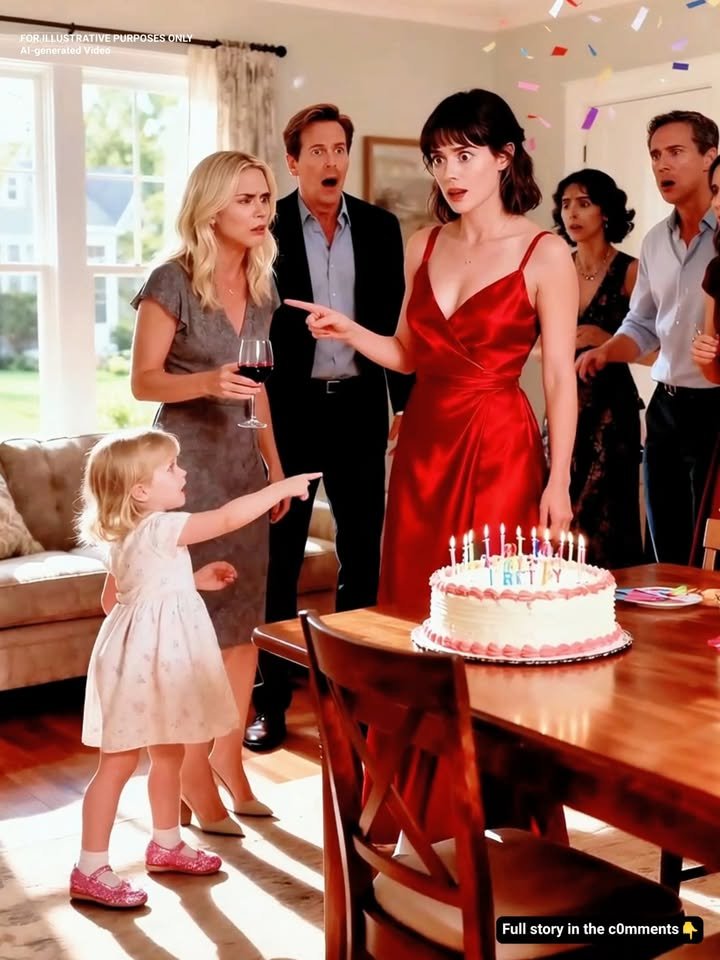
Sometimes, when she asks about her father, I tell her he loves her very much. Because that part, at least, is still true. When friends ask what happened, I don’t mention lipstick or a red dress.
I only say, “My daughter spoke the truth before I was ready to hear it.”
And every time I look at her, I am reminded that sometimes the smallest voices carry the wisdom that adults spend years ignoring. Note: This story is a work of fiction inspired by real events. Names, characters, and details have been altered.
Any resemblance is coincidental. The author and publisher disclaim accuracy, liability, and responsibility for interpretations or reliance. All images are for illustration purposes only.