



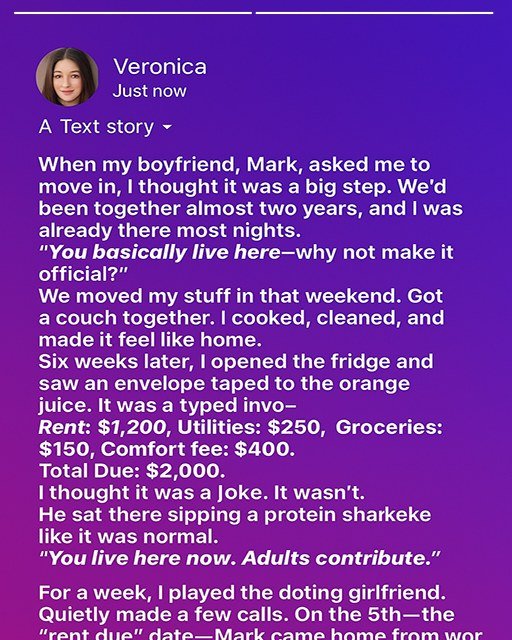
I thought this was about us building a life together, not me becoming your tenant.”
He sighed, running a hand through his hair. “You’re looking at this the wrong way. Couples split expenses.
That’s what responsible adults do. This isn’t about money, it’s about fairness.”
I shook the paper in front of him. “Fairness?
You literally wrote down a ‘comfort fee.’ What even is that?”
He shrugged. “It’s for the little things. The extra electricity when you leave lights on, the extra water from your showers, and the wear and tear of someone else living here.
And, honestly, for my peace of mind. Sharing my space isn’t easy.”
I felt my jaw drop. “So I’m supposed to pay you for the privilege of being your girlfriend?”
“Don’t twist this,” he said, his tone hardening.
“You’re benefiting too. You don’t have to deal with your old landlord, or that noisy street outside your building, or the higher rent. This is cheaper for you in the long run.
And it shows me you’re serious about us.”
The gall of it hit me like a slap. I wasn’t sure whether to laugh, cry, or storm out. Instead, I folded the paper neatly and set it on the counter.
“Let me think about it,” I said quietly, needing space to breathe. That night, I lay awake staring at the ceiling while Mark snored beside me. My mind spun with questions.
Was I overreacting? Was this just his clumsy way of setting boundaries? Or was this a giant red flag waving in my face?
I thought about all the times I’d pitched in without keeping score. I cooked dinner most nights. I picked up groceries on my way home from work.
I’d even paid for our last weekend trip because Mark had “forgotten” to transfer money. Never once had I tallied it up or demanded reimbursement. Because that’s what relationships are supposed to be, give and take, not invoices.
The next morning, over coffee, I tried again to reason with him. “Mark, if you wanted me to contribute to utilities or groceries, you could’ve just said so. I’d have no problem with that.
But this—charging me rent for a place you own outright—it feels wrong. It feels like you’re taking advantage of me.”
He frowned. “You’re making this bigger than it is.
You’re living in my home. Why shouldn’t you pay rent like you would anywhere else?”
“Because I’m not your tenant,” I shot back. “I’m your partner.
Or at least I thought I was.”
For a moment, silence stretched between us. Then he said, almost coldly, “If you can’t handle contributing, maybe you’re not ready for this kind of commitment.”
The irony nearly choked me. Commitment?
To him, commitment meant signing on as a paying guest in his life. To me, it meant love, support, and building something together. Clearly, we weren’t speaking the same language.
I went to work that day in a fog. My coworkers noticed I was quieter than usual, but I brushed off their concern. On my lunch break, I called my best friend, Anna.
“You’re kidding me,” she said after I explained. “He’s literally charging you to be his girlfriend? That’s insane.”
“Maybe I’m being dramatic,” I murmured.
“No,” she said firmly. “You’re not. It’s one thing to split bills when both people are renting a place together.
But he owns his condo. Asking you to pay rent to him is manipulative. It makes you financially dependent on his terms.
That’s not partnership. That’s a landlord situation with kissing privileges.”
Her bluntness made me laugh, despite the lump in my throat. “So what do I do?”
“You already know,” she said gently.
By the weekend, I’d made my decision. I sat Mark down in the living room, the invoice between us on the coffee table. “I’ve thought about this,” I said.
“And I can’t agree to it. I want a relationship where we share things out of love and respect, not out of obligation or financial transactions. If you wanted help with utilities or groceries, I’d gladly contribute.
But I’m not paying you rent, and I’m certainly not paying a ‘comfort fee.’”
His jaw tightened. “So that’s it? You’re just refusing?”
“I’m refusing to be treated like a tenant,” I said quietly.
“If that’s what you need from me, then maybe this isn’t going to work.”
His expression hardened further, and I saw the flicker of something I didn’t like in his eyes. Possessiveness? Resentment?
Whatever it was, it told me everything I needed to know. By Monday, I’d moved my things back into a small apartment of my own. It wasn’t easy—I cried while unpacking, feeling the weight of disappointment—but it was also liberating.
Weeks later, when I told the story to friends over drinks, they were outraged on my behalf but also proud of me. One of them said, “You dodged a bullet. Imagine if you’d married him—he’d be invoicing you for kissing fees by now.”
We all laughed, and I realized they were right.
Better to learn his true colors early than to find out after I’d invested years of my life. Looking back, I see the invoice for what it really was: not about money, but about control. Mark didn’t want a partner; he wanted someone to subsidize his comfort while he dressed it up as fairness.
I’ve moved on since then, and I’m grateful I trusted my instincts. Because love should never come with an invoice attached.