



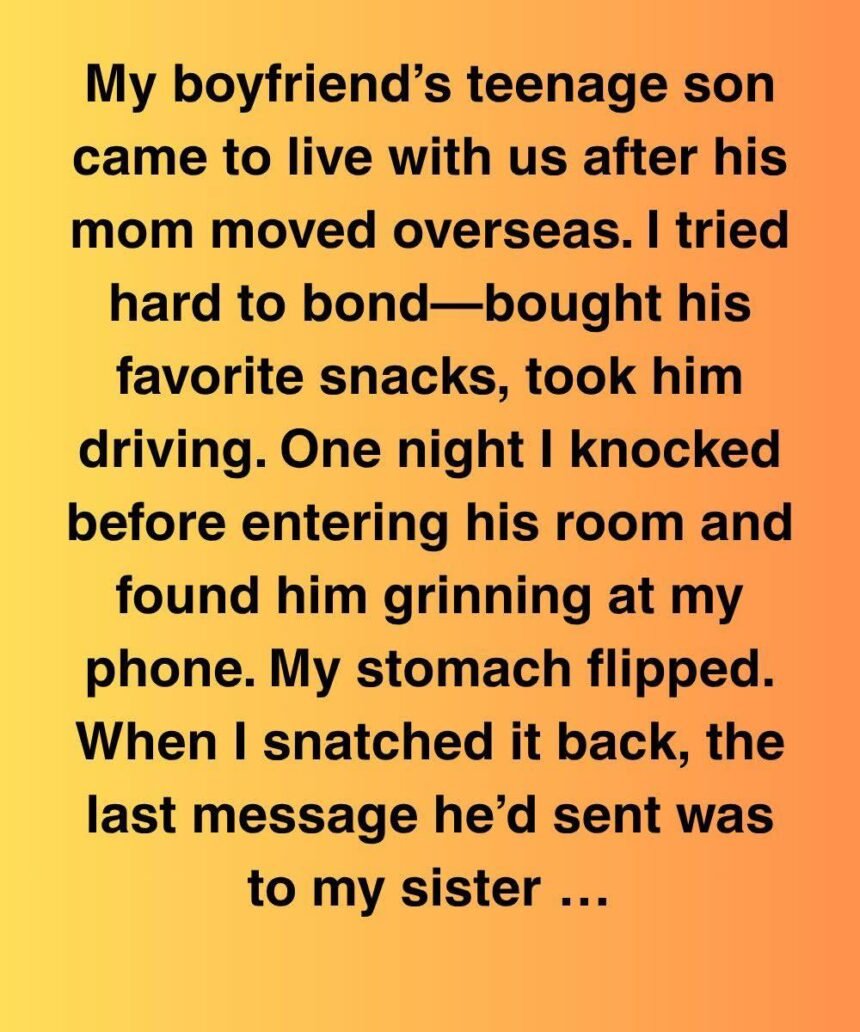
That night, I waited for Ron to come home and told him everything. His face hardened immediately. “He what?”
To my surprise, Ron didn’t yell.
Instead, he walked into his son’s room, shut the door, and talked to him quietly for almost half an hour. When he came out, he looked tired. “I think he’s lonely,” he said.
“He misses his mom, and he’s not adjusting well. But I made it clear that messaging your sister was out of line.”
Over the next few days, things were tense but manageable. I stopped hovering.
Tanya unfollowed him. It seemed like a weird blip that would pass. But then, two weeks later, something else happened.
Ron’s son, Liam, skipped school. The school called around noon. I checked his room—he wasn’t there.
His phone went straight to voicemail. Panic set in. I called Ron at work, who immediately left to start searching.
I drove through every place I could think of—mall, skate park, library. I called a few of his new friends from school. No one had seen him.
Then around 4:00 p.m., my phone buzzed with a text from Tanya:
“Is everything okay with Liam? He showed up at my apartment.”
My heart stopped. I called her instantly.
She picked up and whispered, “He’s here. He said he had a fight with his dad and needed space. I didn’t know what to do.”
“Put him on the phone.”
She handed the phone over, and I heard Liam’s voice, soft and nervous.
“Please don’t be mad. I just wanted to talk to someone.”
“Liam,” I said as calmly as I could, “we were worried sick. I’m coming to pick you up right now.”
“I don’t want to go back.”
“We’ll talk about it, but you can’t just disappear like that.”
When I arrived, I found him curled up on Tanya’s couch, looking smaller than I’d ever seen him.
I thanked my sister quietly and took him home. That night, he opened up. “I don’t belong here,” he said.
“Mom left. Dad works all the time. You’re trying but… I’m just this extra thing no one really asked for.”
His words cut deeper than he probably meant them to.
I told him that we had asked for him. That Ron wanted him here, and I did too. But I admitted it had been bumpy, and we’d made mistakes—not setting clearer boundaries, not giving him space to talk.
From that night on, I made a real effort to connect with him, as myself, not by bribing him with snacks or pretending to like his music. We started having fifteen-minute chats in the morning—just coffee and check-ins. I found out he liked sketching, so I got him a notebook.
I didn’t say it was a gift; I just left it on his desk. Slowly, he opened up. Then one afternoon, maybe a month later, he came home smiling and handed me an envelope.
“For you.”
Inside was a pencil drawing of me and Ron, sitting on the porch. It was beautiful. “I’ve been working on this for a while,” he said.
“It’s from memory. You always sit like that, with your mug tilted and your sock half-off.”
I laughed. “I had no idea you noticed so much.”
He shrugged.
“I notice more than people think.”
That was the beginning of the shift. Ron, for his part, made changes too. He cut down on extra shifts.
He planned a weekend trip just for the two of them to a nearby lake. They came back grinning and sunburned, like old friends reunited. Everything felt like it was finally settling… until another twist came.
One Friday evening, Tanya called me out of the blue, crying. “Are you okay?” I asked. “It’s Mom,” she sniffled.
“She’s being evicted. She didn’t tell anyone. I just found out.”
Our mom, who’d been distant for years, was behind on rent and facing homelessness.
She had always been a proud woman, too proud to ask for help. But life had been hard on her—two divorces, a string of bad jobs, and failing health. Tanya was panicking.
“I don’t know what to do. I can’t take her in, not with my landlord being strict.”
I sighed and stared at Ron across the room. He raised his eyebrows as if to say, Another family fire to put out?
Still, I asked, “Do you think she’d stay here?”
To his credit, Ron didn’t object. “We’ve got a guest room. It won’t be easy, but let’s help her.”
So now, we had Mom living with us too.
At first, it was a circus. She criticized everything—my cooking, Ron’s parenting, even the way Liam walked. But strangely, Liam was the one who softened her.
One evening she was watching her old black-and-white films, and he sat beside her and said, “That guy looks like Elvis if he worked in a bakery.”
She burst out laughing. The ice cracked. They became close in a way I hadn’t expected.
She even gave him art books from her thrift shop collection and bragged about his sketches to anyone who’d listen. And for the first time, I saw my mother happy. Not critical, not bitter.
Just… present. Then, one night, she took me aside and said something I won’t forget. “I wasn’t a great mom to you.
But I see the kind of woman you’ve become, and I’m proud. You make a real family out of chaos.”
I cried in the laundry room for a full ten minutes after that. The biggest surprise came months later.
Ron proposed. He didn’t do it with a ring or a fancy dinner. He just sat with me on the porch one quiet evening and said, “We’ve been through enough tests.
I still want a life with you. Do you still want one with me?”
I said yes before he even finished. We married in a small backyard ceremony.
Liam stood beside Ron, proudly holding the rings. Tanya cried the loudest. And my mother wore her old green dress and called it the best day she’d had in twenty years.
Later that night, Liam handed me a second drawing. This one showed all five of us—me, Ron, Liam, Mom, and Tanya—crammed into the living room, with mismatched socks, popcorn bowls, and a movie on screen. He’d titled it “Found Family.”
It still hangs on our wall.
Looking back, I realized something. When people hurt or misstep, it’s easy to write them off. Especially kids.
But often, they’re just reaching for connection in the messiest ways they know how. Liam didn’t need discipline as much as he needed patience. My mom didn’t need fixing—just shelter and a second chance.
Even Tanya, with her careless charm, had a core of fierce loyalty when it counted. We all had sharp edges. But we learned to fit anyway.
And that’s the thing about family: it isn’t about who gets it right from the start. It’s about who’s still standing beside you at the end, willing to keep trying. If this story touched you, give it a like and share it with someone who believes in second chances—because sometimes, family is something we build, not something we’re born into.