



His corporate headquarters sits on our land, Lot 47. He’s been our tenant for 15 years.”
The room spun. “Vincent Harlo rents from us?”
“From you, now.
And there’s a clause I insisted on when we wrote the original contracts: any tenant who violates ethical business practices can have their lease terminated with 30 days notice.”
I thought of my daughter, Bethany, struggling with nursing school tuition. My son, Christopher, offering money he didn’t have. The humiliation of delivering pizzas to former colleagues.
“Mr. Drummond,” I said, slowly standing. “I think it’s time Vincent Harlo met his new landlord.”
Walter smiled.
For the first time in six months, I felt hope. Not just for money or revenge, but for justice. The man who’d crushed me was about to learn that karma sometimes comes with a 30-day eviction notice.
Six months earlier, I had a perfect life. 23 years at Harlo Industries, a corner office overlooking the Philadelphia skyline, and a respected team. My kids, Bethany and Christopher, were thriving.
Felicia, my ex-wife, who’d left me for a real estate developer who went bankrupt, was a distant memory. We could joke about her constant need for money, status, everything. Then came the company gala in June.
Vincent Harlo, the CEO, approached me with a woman on his arm. “Ray,” he boomed, “I want you to meet my fiancée.” My blood turned to ice. Felicia stood there, draped in diamonds and a designer gown, a predatory smile on her face.
“Hello, Ray,” she said sweetly, “It’s been too long.”
“Felicia’s been telling me all about your history,” Vincent said, his hand on her waist. “Small world, isn’t it?”
My team froze. I forced a smile.
“Congratulations. They’re doing great,” I said, cutting off her saccharine inquiries about the kids before making my escape. My assistant, Janet, found me later.
“You okay, boss? That looked rough.”
“It’s fine, Janet. Ancient history.”
“If you say so, but be careful.
That woman looked at you like a cat who just spotted a mouse.” Janet was more perceptive than she knew. Over the next weeks, Felicia started appearing everywhere at work. She’d drop by my department during lunch, attend meetings, whispering in Vincent’s ear while looking at me.
“Dad, something’s wrong,” Christopher said. “You look exhausted.”
“Just work stuff. Vincent’s fiancée is Felicia.” Bethany dropped her fork.
“Mom is marrying your boss?”
“It’s fine. I just have to stay professional.”
“Dad, you need to document everything,” Christopher said in his lawyer voice. “This feels like trouble.”
My mother, Dorothy, would have seen it coming.
She always said, “Raymond, you’re too trusting, just like your father. Thomas saw the good in everyone, even when there wasn’t any good to find.” Mom had raised me alone after Dad died in that car accident when I was two. She worked double shifts for 30 years, putting me through school.
She died peacefully three years ago, leaving me a box of my father’s things and a warning: “The world isn’t always fair, Raymond. But the truth has a way of finding daylight.”
I should have listened to Christopher. I should have seen the trap.
But I believed in the system, in hard work. I was wrong. The destruction of my life happened in exactly 72 hours.
It began with a call at 7:30 on a Monday. “Raymond, we need you in human resources immediately,” HR Director Carol Patterson said, her tone chilling. Carol sat behind her desk, two security guards flanking the door.
“There’s been a serious allegation of theft,” she said, sliding documents toward me. “$2 million of inventory is missing from warehouse 7. The digital access logs show your override codes were used every single time.”
“That’s impossible.
I haven’t been in warehouse 7 in three months!”
“The records say otherwise. Every transaction has your digital signature. 47 separate diversions over the past 90 days.” My hands shook as I reviewed the papers—my code, my signature, my supposed login times, all while I was home asleep.
“This is fabricated. Check the security cameras. They’ll show I wasn’t there.”
“The cameras malfunctioned during all relevant time periods.
The backup system also failed. Mr. Harlo wants this handled quietly.
Resign now, sign this non-disclosure agreement, and there won’t be criminal charges.”
“I want my lawyer.”
“That’s your choice. But Mr. Harlo was hoping to avoid embarrassing your family.
Your son Christopher just made partner, didn’t he? It would be a shame if his firm learned his father was a thief.”
The threat was clear. “I’m not resigning for something I didn’t do.”
“Then you’re suspended, effective immediately.
Security will escort you out.”
The walk of shame through the office I’d helped build was the longest of my life. My team watched, Janet crying, Dennis from accounting avoiding my eyes. Tuesday brought the police.
Six officers showed up with a warrant, tearing through my house, confiscating everything. Mrs. Henderson next door watched as they led me out in handcuffs.
“Dad, what’s happening?” Bethany sobbed over the phone. “It’s a misunderstanding, sweetheart.”
By Wednesday, it was clear it was no misunderstanding. Every major logistics company in the tri-state area had received an email from Harlo Industries about my “integrity issues” and “ongoing investigation for corporate theft.” My LinkedIn flooded with people distancing themselves.
23 years of relationships evaporated in 23 hours. Felicia’s text came Wednesday evening: “Enjoy being nobody, Rey. You always were too small for the life I wanted.
Vinnie sends his regards.”
“I need a lawyer who isn’t afraid of Vincent Harlo,” I told Christopher. “Dad, I’ll represent you myself.”
“No, you just made partner. I won’t let them destroy your career, too.”
The lawyer I hired cost $500 an hour.
By week three, my savings were hemorrhaging. By month two, the house went into foreclosure. The legal bills had eaten everything, and we were no closer to proving my innocence.
Vincent Harlo had an army of attorneys and buried us in paperwork. “Rey, I hate to say this, but they’ve done this before,” my lawyer finally admitted. “Vincent Harlo has a pattern.
Three other executives who crossed him ended up with similar accusations. None of them could prove their innocence.”
“So, I’m just supposed to give up?”
“I’m saying you’re David fighting Goliath, except Goliath owns all the stones.”
I sold everything: the house, the car, my father’s watch. Christopher tried to give me money, but I refused.
Bethany offered to leave school, but I’d rather die than let her sacrifice her future for Vincent’s lies. Luigi’s Pizza was the only place that didn’t run a background check. Luigi Marelli, the owner, was old school.
“You show up, you work hard, you get paid. I don’t care what the papers say.”
Delivering pizzas at 50 was a special kind of humiliation. My first delivery was to someone from my old department.
The second to a neighbor. The third to one of Felicia’s friends, who laughed and tipped me a condescending $20. “Raymond Grant.” Dennis from accounting caught me at a red light.
“Man, I heard what Harlo did to you. Everyone knows it’s false, but nobody will cross him. He owns half the city.”
Three months into this new life, I’d stopped fighting.
Pride was a luxury I couldn’t afford. I delivered pizzas, lived in a studio apartment that smelled of mildew, and avoided places from my old life. The man who’d run logistics for a billion-dollar company now worried about gas money.
That December night, driving through the rain to Beacon Hill, I thought I’d accepted my fate. I was nobody, just like Felicia said. I had no idea Walter Drummond would change everything.
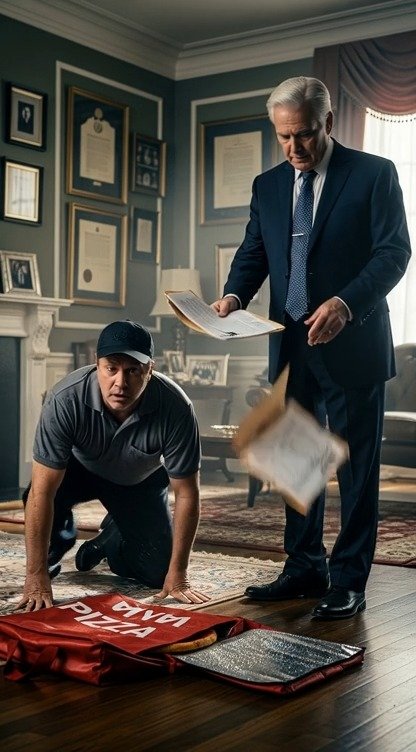
The order was for 1247 Beacon Hill Drive. A large pepperoni with extra cheese. The December rain hammered my windshield as I pulled up to the massive colonial house.
These Beacon Hill deliveries usually meant good tips. I grabbed the insulated bag and ran through the downpour. When Walter Drummond opened the door and fell to his knees, my world tilted.
“Come in, please. You need to come inside,” Walter said, pulling me in. “I’ve been searching for you for 30 years, Raymond.”
His living room was a museum to the past.
Black and white photographs, documents, boxes of papers. The pizza bag dropped from my numb fingers as Walter grabbed a specific photograph from the mantle. “This is your father and me.
1982, the day we incorporated Drummond Grant Developments.” Two young men stood in front of a massive tract of swampland, hard hats in hand, grinning. My father looked exactly like me at 25. “Tommy and I met at a construction site in Jersey,” Walter explained, his words tumbling out.
“We were both foremen, both dreamers. We’d spend our lunch breaks talking about making it big, about building something that mattered. Then the Riverside land came up for auction—60 acres of swamp that nobody wanted.” Walter pulled out the incorporation papers.
“Your father scraped together $50,000, his entire life savings plus a loan against your parents’ house. I matched it. We were equal partners, 50/50.
Everyone laughed at us.”
“My mother never mentioned any of this,” I said. “Because we failed, or thought we did. The city rejected our development permits six times.
The environmental board said the land was protected wetlands. Your father was devastated. He’d risked everything, mortgaged your family’s future on a dream.
Two months later, he died in that car accident on Route 76, thinking he’d ruined your mother’s life and yours before you were even born.” Walter’s eyes filled with tears. “I went to the funeral. Your mother was eight months pregnant, completely broken.
When I tried to explain about the company, she screamed at me to get out. Said she never wanted to hear about Tommy’s failed dreams again. She moved away right after you were born.”
Walter walked to a filing cabinet and pulled out folder after folder.
“Six months after Tommy died, everything changed. The state announced a new technology corridor initiative. Suddenly, our worthless swampland was prime real estate.
The permits were approved overnight, but I couldn’t find you or your mother.”
“So, you developed it alone?”
“I developed it for both of us. Every contract, every lease, every decision, I asked myself what Tommy would want. I put his 50% in a trust, collecting rent, accumulating interest, waiting for the day I could find his son.”
Walter showed me lease agreements, bank statements, 30 years of meticulous records.
Google, Microsoft, three major hospitals, 47 office buildings—all paying rent to Drummond Grant Developments. The numbers were staggering. “$823 million,” Walter said.
“That’s your father’s share as of today, but Raymond, there’s something more important than the money.”
He pulled out a specific lease agreement. My blood froze. Vincent Harlo’s signature stared back at me.
“Harlo Industries has been our anchor tenant for 15 years. Lot 47, the crown jewel of the corridor. His entire operation runs from that building.
The lease comes up for renewal next month.”
“You’re telling me Vincent Harlo rents from us?”
“From you, now. And there’s a morality clause I insisted on in every lease: any tenant convicted of fraud, theft, or unethical business practices can be evicted with 30 days notice. Your father wanted honest businesses on our land.”
I thought of Felicia’s text, of being “nobody,” of Bethany and Christopher, of three months delivering pizzas while Vincent Harlo destroyed lives for sport.
“Walter,” I said, my voice steady for the first time in months. “I need you to introduce me to your lawyers, the best ones you know.”
“Already done. Patricia Norwood from Norwood, Cain and Associates.
She’s expecting your call. Raymond, your father would be so proud. You survived what would have broken most men.”
“I haven’t survived yet,” I said.
“But Vincent Harlo is about to learn what it feels like when the ground shifts beneath your feet.”
Within a week, Patricia Norwood’s team confirmed everything, establishing my inheritance and, crucially, reviewing every lease. Walter’s morality clause was ironclad. “Mr.
Grant,” Patricia said in her downtown office, “You don’t just own the land under Harlo Industries. You own the leverage to destroy him completely. His entire operation depends on that location.”
“How soon can we move?”
“We already have.
I’ve filed the paperwork establishing your ownership and sent formal notice that you’ll be personally reviewing all lease renewals. Mr. Harlo’s attorneys have been calling non-stop.”
My phone buzzed.
Felicia. I let it ring. The next morning, I sat in my Honda Civic outside Harlo Industries, holding the folder containing Vincent’s future.
The building towered, 40 stories of glass and steel built on my father’s dream. The security guard, who used to wave me through, now looked right through me. That would change in 30 minutes.
My phone rang again. This time I answered. “Ray.” Felicia’s voice was tight with panic.
“Vincent’s freaking out about some lease issue. His lawyers are saying something about ownership changes. You wouldn’t know anything about this, would you?”
“Actually, I would,” I said, watching Vincent’s Bentley pull into his reserved spot.
“Tell Vincent his new landlord wants to discuss his recent business practices. The meeting is in 20 minutes. Oh, and Felicia, that boring man you left?
He owns the ground your penthouse sits on. It’s all built on Drummond Grant land.”
The silence was beautiful. Then came the shriek.
“That’s impossible! You deliver pizzas!”
“Not anymore. See you in the conference room.”
I walked through the lobby in my best suit.
Patricia Norwood’s team—six lawyers in perfect formation—swept in behind me. “We’re here for the emergency meeting with Mr. Harlo,” Patricia announced.
The elevator ride to the 40th floor felt like ascending to justice. Vincent was already there with his 12 lawyers and a pale Felicia. “Hello, Vincent,” I said, taking the head of the table.
“Thank you for agreeing to meet with your landlord.”
Vincent’s face cycled from confusion to fury to terror. “This is some kind of joke.”
Patricia slid the ownership documents across the table. “No joke, Mr.
Harlo. Mr. Grant inherited 50% of Drummond Grant Developments from his father.
As of last week, he’s assumed full control of lease negotiations for Lot 47.”
“You can’t do this!” Vincent snarled. “We have a lease which expires in 30 days,” I said calmly, “and contains a comprehensive morality clause. Patricia, would you share what our investigators found?”
Patricia opened her laptop.
“Seventeen former employees have provided sworn affidavits about false accusations, planted evidence, and targeted harassment. We have three who were accused of theft using the exact same method used against Mr. Grant.
Digital signatures, mysteriously malfunctioning cameras, the whole playbook.”
“You can’t prove anything!”
“We don’t have to,” I said. “The morality clause doesn’t require conviction, just credible evidence of unethical business practices. But here’s my offer, Vincent.
You have two choices.” I looked down at the man who destroyed my life for sport. “Option one: you vacate the premises in 30 days. Good luck finding 40 floors of specialized space.
Or…”
His voice cracked. “Option two: you publicly clear my name, pay me $30 million in damages, and sign a lease at triple the current rate. Oh, and you divorce my ex-wife immediately.”
“You can’t force me to divorce her!” Vincent slammed his fist.
“No, but I can make staying married to her very expensive. Every month you remain married, the rent doubles. Month 1: $6 million.
Month 2: $12 million. Month 3: $24 million. How long before your board decides she’s not worth it?”
Felicia stood, her heels clicking as she backed toward the door.
“Ray, baby, we can work this out! I never meant for things to go this far.”
“Save it,” I said, not looking at her. “Vincent, you have 24 hours.
After that, I start the eviction process and go public.”
Vincent’s lead attorney whispered urgently. The color drained from Vincent’s face as he realized his empire stood on land I controlled. “This is extortion!”
“No,” Patricia corrected.
“This is contract law. The same law you used to destroy innocent people. Mr.
Grant is being generous.”
I turned to leave, then stopped. “By the way, Vincent, that text Felicia sent about me being nobody? Thank her for me.
It’s been very motivating.”
Vincent chose to fight. He lost spectacularly. Within 48 hours, his board received copies of every affidavit and piece of evidence.
The Philadelphia Inquirer got an anonymous tip, and suddenly Vincent Harlo was the billionaire who destroyed working families for sport. He resigned, divorcing Felicia within a week. Felicia sent dozens of desperate texts.
“Ray, please! I made a mistake! We were married for 20 years!
I’m going to be homeless!” She even showed up at Luigi’s one night. “Your order will be ready in 15 minutes, ma’am,” I said, walking past her to my car. “I’m sorry!
Is that what you want to hear? I’m sorry for everything!”
I stopped and turned. “No, Felicia.
You’re sorry you got caught. You’re sorry the money’s gone. You’re sorry you backed the wrong horse.
That’ll be $23.50 for the pizza.” She threw the money at me and left. It was the last time I saw her. The 17 former employees Vincent had destroyed each received $2 million from the settlement fund we established.
Dennis from accounting, forced out years earlier, cried when he got the call. “Ray, you didn’t just save yourself, you saved all of us.”
Walter Drummond became the grandfather I never had. We spent evenings going through my father’s old papers.
“Your father always said,” Walter told me, “Wealth without purpose is just paper, but wealth with purpose can change the world.”
We converted half of the Riverside corridor into affordable housing. The Thomas Grant Foundation launched with a $100 million endowment to help families affected by corporate retaliation. In the first year, we helped 300 families.
Bethany graduated debt-free and now runs a free medical clinic we built in North Philadelphia. “Dad,” she said, “You showed me that falling down doesn’t define you. Getting up does.” Christopher started his own law firm, specializing in defending employees against corporate harassment.
His first case, pro bono, defended a janitor accused of theft. We won. My granddaughter, Dorothy, Christopher’s newborn, will grow up in a world where her family name means something.
Not because of money, but because when we got power, we used it to protect those who didn’t have any. Standing in my father’s old office, now mine, Walter placed his hand on my shoulder. “Tommy would be proud.
You didn’t just reclaim your wealth. You reclaimed his dream of using success to lift others.”
I looked at the photo of my father on the wall, that young man full of hope, standing in front of worthless swampland. He’d died thinking he was a failure, never knowing he’d built an empire.
But more importantly, he’d built it with integrity, with clauses that demanded ethical behavior, with a vision that business should serve communities, not destroy them. The best revenge wasn’t the money or the power. It wasn’t watching Vincent lose everything or Felicia’s desperate texts.
The best revenge was the text I sent Felicia on what would have been her first wedding anniversary with Vincent. It was a photo of me handing keys to a young single mother, another victim of corporate retaliation, as she moved into her new apartment in our affordable housing complex. The message read, “This is what being somebody looks like.”
She never responded, but Thomas Grant’s son didn’t need her to.
I’d learned the most important lesson of all. Sometimes being nobody is just the universe’s way of preparing you to become somebody who matters. And sometimes the ground beneath your feet isn’t pulling you down.
It’s getting ready to lift you up. My father left me more than money. He left me purpose, and that’s worth more than $800 million could ever be.