


He straightened and vanished through the gates. The week dragged on quietly, and I dared hope Malachy had moved on. I should’ve known better.
Friday afternoon, Camden came home with a torn shirt sleeve and a bruise blooming on his cheek. He tried to slip past to his room, but I caught his arm. “Camden.
Oh, honey, what happened?”
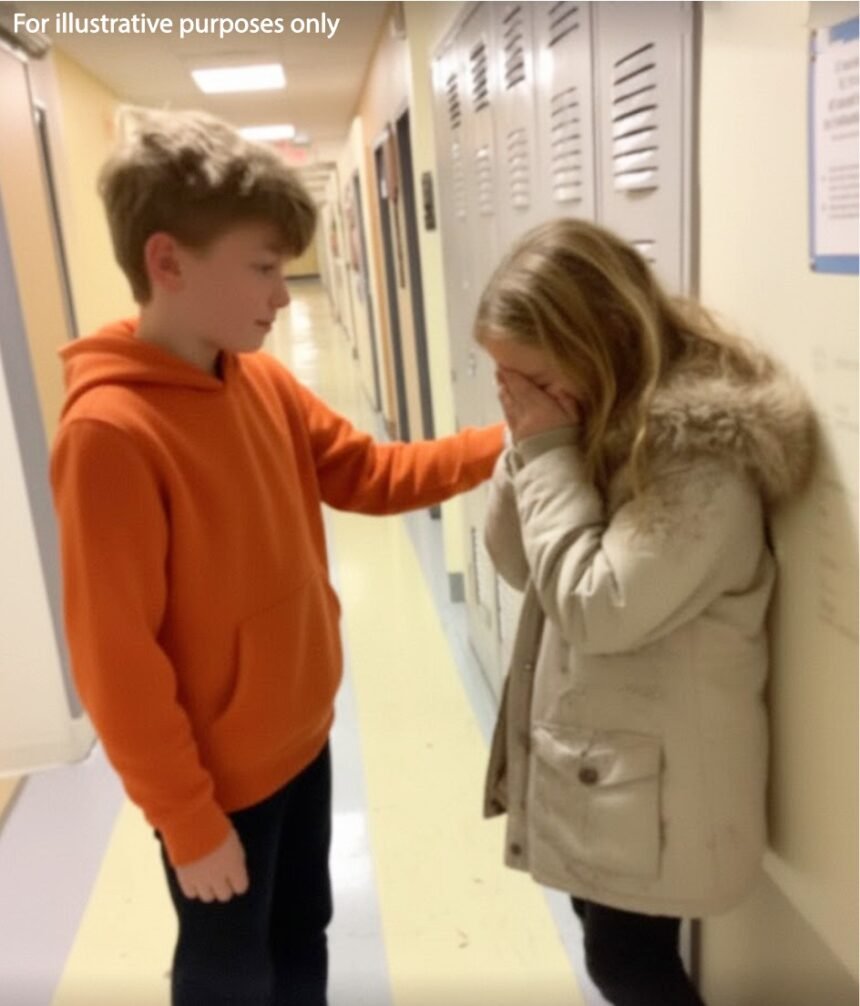
He avoided my eyes. “Malachy shoved me into the lockers after lunch. Called me names.
It’s fine.”
“It’s not fine.” I gently tilted his chin to check the bruise. “What names?”
“‘Poor kid protector.’ ‘Trashcan hero.’ Stuff like that.” He pulled away, heading for his room. “Some kids think I should’ve stayed out of it.
They’re saying I caused trouble for nothing.”
I wanted to storm the school and demand answers, but Camden didn’t need my rage. He needed to know I trusted him to handle this, with me ready to step in if it escalated. That evening, the school called.
The vice principal wanted a meeting to discuss the “incident.” I agreed, expecting a lecture on conflict resolution. But I wasn’t ready for the call three days later. It was late, nearly nine.
Camden was asleep, and I was folding laundry when my phone rang with an unknown number. My gut screamed to answer. “Is this Camden’s mother?” The voice was sharp, male, cold enough to prickle my skin.
“Yes, who’s this?”
“Mr. Theron, Malachy’s father.” A pause, heavy with threat. “Your son humiliated mine in front of his friends.
That’s unacceptable. Be at my office tomorrow, nine sharp, to discuss how you’ll fix this. If you don’t show, there’ll be consequences.”
My throat went dry.
Mr. Theron ran Theron Prestige Autos, his face on billboards citywide. He had money, influence, and no qualms about intimidating a single mom.
“Mr. Theron, my son was defending a little girl who was being harassed—”
“Nine a.m. My office.
Don’t be late.” The line went dead. I stood frozen, phone in hand, heart hammering, wondering what I’d dragged us into. Mr.
Theron’s office was a fortress of glass and steel, built to make you feel small. The lobby’s marble floors gleamed, and abstract art worth more than my yearly income lined the walls. The receptionist eyed my thrift-store blazer and sensible shoes with a faint sneer.
“Mr. Theron’s expecting you,” she said, as if I were late despite being ten minutes early. “Follow me.”
She led me to a corner office with towering windows over the skyline.
Mr. Theron sat behind a sleek desk, his suit likely worth more than my car. He didn’t stand or offer a handshake.
“Sit,” he ordered. I sat, clutching my purse, willing my hands steady. “Your son shamed mine,” he began, voice icy.
“Malachy came home upset, and I don’t appreciate dealing with school drama because you haven’t taught your kid boundaries.”
Anger surged, hot and sharp. “My son stood up for a seven-year-old girl mocked for being poor. If anyone needs a lesson in boundaries, it’s—”
“I’m not done.” He leaned forward, and I braced for another threat.
But his face softened, the hard edges giving way to something raw, almost broken. “Malachy told me everything,” he said. “What he said to that girl.
How your son called him out. How the other kids laughed.” He rubbed his face, weary. “And I saw something I should’ve noticed years ago.
I’ve raised a cruel kid.”
I blinked, thrown by the shift. “I’ve given Malachy everything money can buy,” he went on. “Top schools, the latest tech, trips most kids dream of.
But I never taught him compassion. Never showed him what it’s like to struggle or respect people regardless of what they have.” He looked at me, eyes heavy. “Your son did what I failed to do.
He held up a mirror and made Malachy see himself.”
Silence stretched, thick with unspoken truths. “I called you here to apologize,” Mr. Theron said at last.
“And to thank you. Camden gave my son something more valuable than anything I’ve bought him—a chance to be better.”
He slid a check across the desk. “For Camden.
His education, his dreams, whatever he wants.”
I glanced at the staggering number and pushed it back. “I can’t take this. Camden didn’t act for a reward.”
“I know,” Mr.
Theron said. “That’s why he deserves it. And if you ever need anything, call me.
Tell Camden that Malachy will do better. I’ll make sure of it.”
When I got home, Camden was at the kitchen table, sketching a new comic. He looked up, worry etched on his face.
“How bad was it?”
I sat across him. “Not bad at all. Mr.
Theron wanted to thank you.”
His brows shot up. “Thank me? For what?”
“For teaching his son something he should’ve taught long ago.
About kindness. About respect.” I ruffled his hair. “You made a bigger impact than you know.”
“Does that mean Malachy’s gonna stop being mean?”
“Maybe not right away.
But his dad’s working on it.”
Camden nodded, processing. “I didn’t do it to change Malachy. I just didn’t want Eira to feel awful.”
“I know, sweetheart.
That’s what makes you special.”
Over the next weeks, small changes rippled out. Camden said Malachy apologized to him in the hallway, stiff but sincere. Eira showed up with a new coat and a proper backpack.
Word spread that Mr. Theron had offered Eira’s mom a full-time job at his dealership, with benefits. No grand gestures, no fanfare.
Just quiet steps toward righting wrongs. One night, tucking Camden into bed, he looked up with sleepy eyes. “Do you think people can really change?”
“I think they can, if they want it enough.
And if someone shows them why.”
He smiled. “Can I put Eira in my next comic? Maybe as a superhero?”
“Only if she’s the hero of her own story.”
“Deal.”
As I turned off his light and closed the door, I thought about how the biggest shifts start with the smallest acts of bravery.
A 10-year-old boy with a sketchbook and a heart, standing up when it mattered. Sometimes, that’s all it takes to nudge the world closer to what it should be. The powerful need reminding that their power carries responsibility.
And sometimes, that reminder comes from the unlikeliest source—a quiet kid who couldn’t stand by and watch someone hurt.