

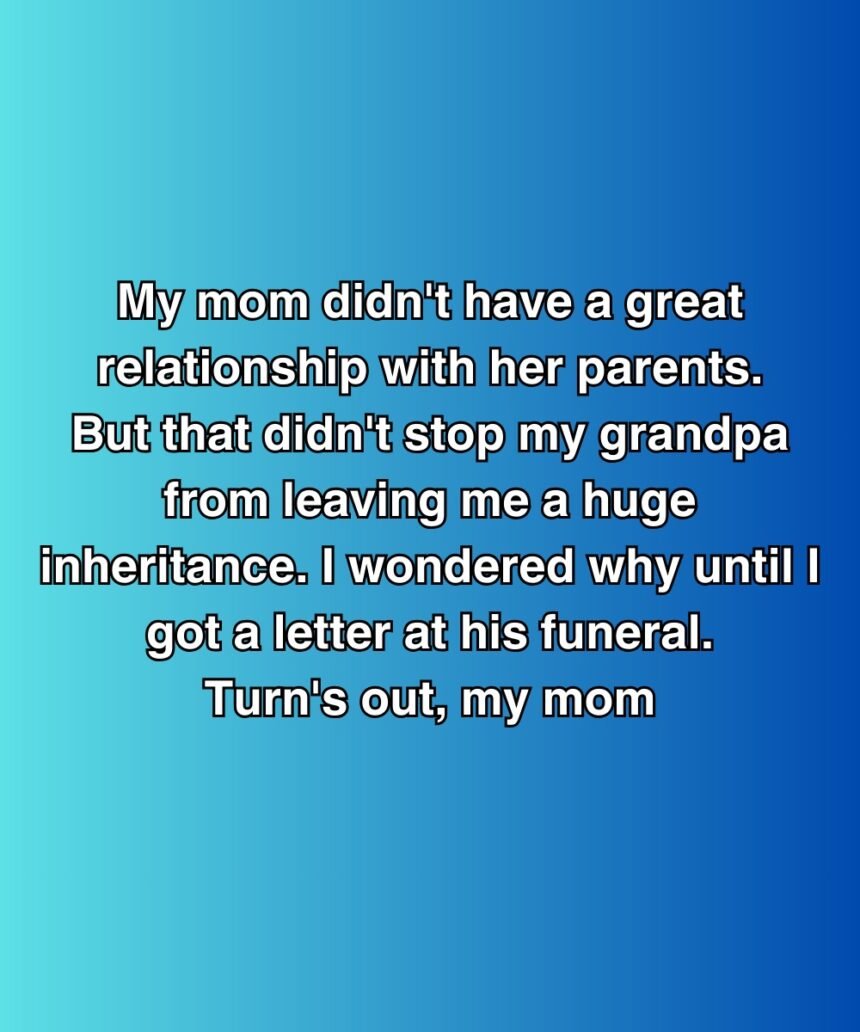
No—it was because Andrei wasn’t interested in getting married, and Grandpa believed a child deserved a stable, two-parent home. My mom refused to listen. She was in love, said she’d raise the baby herself if she had to.
They had a massive falling out. My mom moved in with Andrei. But six months later, she miscarried.
After that, everything crumbled. Andrei left the country—visa issues, maybe heartbreak. My mom spiraled.
She never spoke to her dad again. She met my father a year later, married him fast, and never looked back. The folder even had unsent letters Grandpa had written to her.
Some were angry. Others heartbreaking. All of them showed a man struggling with pride, regret, and love he didn’t know how to express.
It made me cry in the middle of that dusty little study. For a week I stayed in the house, just trying to feel him. I found a drawer full of programs from school plays, newspaper clippings of the nonprofit I co-founded, even an old polaroid of me on my high school graduation day—from across the stadium, zoomed in and a little blurry.
He really had been watching. Quietly. I called my mom.
Told her I knew. She went silent on the phone for nearly thirty seconds. Then said, “I don’t want to talk about it.”
But she came up to visit a week later anyway.
We walked through the house slowly. She touched the frame of a door, looked out the kitchen window, but said almost nothing. Then in the living room, she sat down, exhaled, and finally said, “I hated him for a long time.
But maybe I hated myself more.”
I didn’t press. I just sat with her. Over the next few weeks, I debated what to do with the inheritance.
I could’ve sold everything and walked away. But it didn’t feel right. Instead, I did something unexpected.
I used the money to start a foundation—The Sato Second Start Fund. Small grants for single parents trying to rebuild. I knew firsthand how hard it was to get something off the ground, and I liked the idea of turning old pain into someone else’s fresh beginning.
But that’s not even the biggest twist. A few months after launching the foundation, I got an email. The subject line said, “Inquiry re: Sato Fund.”
It was from a woman named Ilinca.
Said she was from Bucharest. And she believed we might be related. I thought it was spam.
But she attached photos. One of a man who looked eerily like me—except older, with deep-set hazel eyes. The same eyes I saw every day in the mirror.
She claimed her father, Andrei, had spoken of a lost love in California. A girl named Noriko who’d had a miscarriage, or so he was told. He’d returned home devastated.
He passed away in 2017, but before he died, he’d told her about the baby that never was. Ilinca had spent years wondering if he’d ever had more children, or if that chapter of his life had truly ended. I called her.
We spoke for nearly two hours. She was kind, sharp, and full of emotion. We shared stories.
And when I told her I was Noriko’s daughter—not from Andrei, but from after—she still broke into tears. “I guess we’re not sisters,” she said. “But somehow, we’re still family, no?”
We met later that year when she came to San Francisco.
My mom was hesitant at first, but when she saw Ilinca, something softened in her. They hugged. Long.
“I’m sorry my father never found the right way to stay,” Ilinca whispered. My mom didn’t reply right away. But when she finally did, she said, “Maybe this is him, staying after all.”
These days, Ilinca helps manage part of the foundation’s European outreach.
We Zoom every week. She calls my mom “Tantă,” which means auntie in Romanian. And Grandpa’s house?
I turned it into a transitional home for young mothers. There’s a photo of him in the entryway—stern but kind, holding one of my childhood programs in his lap. Sometimes I catch myself wondering what life would’ve been like if none of the drama had happened.
If my mom and grandpa had just… stayed close. If Andrei had stayed in the U.S. But maybe that’s not the point.
Sometimes love shows up quietly. Sometimes redemption comes decades late, through letters, strangers, and unexpected gifts. My grandfather couldn’t say “I’m sorry” out loud.
But in his own quiet way, he made sure I had the chance to. And that’s something I’ll always carry with me. If you’ve ever held onto a grudge too long, or wondered if it’s too late to fix something—it’s not.
Sometimes the apology comes in a different form. A letter. A gesture.
A second chance passed down. Share this if it reminded you of someone you still have time to reach out to. ❤️