


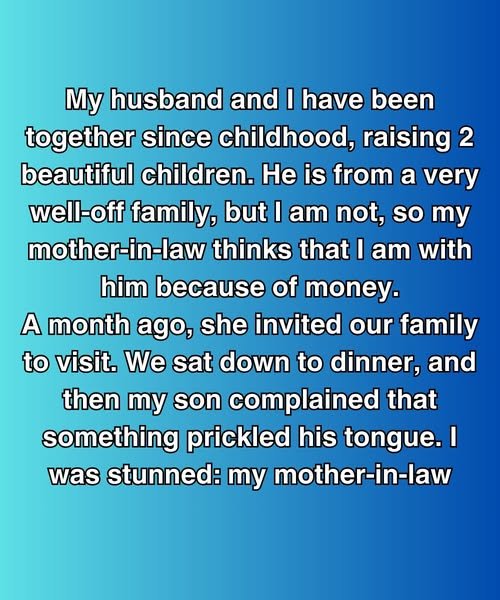
She put something in our child’s food, Dario.”
He kept rubbing his temple, silent for too long. Then he said, “Maybe it was an accident. Maybe she cleaned something with a contaminated cloth—”
“She cooked it, Dario.
She served it to him.”
Then came the line that shattered me: “You don’t have any proof she did it on purpose.”
I stared at him. “Do you need a video of her sprinkling it in?”
He got defensive. Said I was always looking for reasons to make his mom out to be a villain.
Said maybe this was my resentment talking. I didn’t scream. I didn’t cry.
I just walked out of the room and went to lay with our kids. For the next few days, I kept my distance—from both him and his family. I didn’t answer his mother’s calls, and she didn’t try hard anyway.
I busied myself with school drop-offs and grocery runs, but I was watching him. Watching the way Dario avoided my eyes. The way he spent more time at work.
Then came the twist I never saw coming. One afternoon, Dario came home early. He looked shaken.
Pale. He handed me his phone without saying anything. It was a video, taken on his cousin’s door camera, apparently from a week before the dinner.
It showed his mom standing on the porch, talking with someone—a neighbor, maybe. The audio was faint, but I heard her clearly say, “If she’s going to poison my son with her neediness, maybe she should see how it feels when her kids suffer.”
The neighbor laughed nervously and said, “That’s dark, Lina.”
His mother just said, “Sometimes, you have to teach people their place.”
Dario sat down hard on the couch. “I—I didn’t know she said this.
Emilio just sent me the footage.”
I said nothing. He buried his face in his hands. “What kind of person does that to her own grandchild?”
I said, “One who’s never truly seen them as hers.”
We didn’t speak much that evening.
But later, Dario asked if he could take the kids to his cousin’s house for the weekend. I said yes, as long as his mother wasn’t within five miles. He promised.
While they were gone, I started cleaning. I needed to feel control over something. As I cleared out the basement shelf, I found a box I hadn’t seen in years—letters.
Old photos. High school yearbooks. Love notes from when Dario and I were just kids.
I sat on the cold floor and cried, because I missed that version of us. The simple one. The untainted one.
When he came back Sunday evening, he looked calmer. “I’ve talked to her,” he said. “Told her she’s not welcome around the kids.
Not until she apologizes. And even then, only supervised.”
I looked at him. “And do you believe she meant to do it?”
He nodded slowly.
“I do now. I should’ve seen it sooner.”
He kept his word. No more visits.
No more dinners. No more pretending. But healing wasn’t instant.
We had tough conversations. About loyalty. About protection.
About the things we sweep under the rug in the name of “family.”
Months passed. My son stopped talking about the dinner. My daughter asked once why Grandma didn’t come anymore, and I said, “She made a mistake, and we’re keeping safe.” Kids understand more than we give them credit for.
Then one morning, we got a letter in the mail. No return address. But I knew that handwriting anywhere.
It was from her. She wrote, I was wrong. I was bitter and scared you’d take him away from us.
But I see now, I nearly destroyed everything. I don’t expect forgiveness. I just want you to know I failed you, and I’m sorry.
I read it once. Then again. Then I put it away in a drawer.
Forgiveness doesn’t always come with a welcome mat. But here’s where the twist comes. A few weeks later, we were at a park.
My son was playing soccer with his friends, and I was chatting with another mom. She looked familiar, and after a few minutes, I realized she was the neighbor from the video. The one who heard my mother-in-law say those chilling words.
I told her I recognized her, and she smiled nervously. Then she surprised me. She said, “I was hoping I’d see you.
I wanted to tell you…I reported it.”
“Reported what?”
“The video. To child protection. I didn’t include your names, but I flagged it.
What she said wasn’t okay.”
I was stunned. “You didn’t have to do that.”
She shook her head. “I did.
I lost a sister to neglect when I was a kid. I know the signs. I know how things can spiral.”
We stood in silence for a bit.
Then she said, “You protected your kids. That’s more than a lot of people manage.”
On the drive home, I thought about that. About all the times I questioned myself.
Wondered if I was making too much of it. Wondered if I was ruining a family over a suspicion. But here’s the truth I’ve come to learn: Protecting your peace isn’t petty.
Setting boundaries isn’t betrayal. Sometimes the people who raised us are the very ones we have to shield our children from. And sometimes, karma doesn’t come loudly.
Sometimes it shows up as isolation. As self-reflection. As a handwritten apology sent in silence.
Dario and I are still rebuilding. But he sees it now. All of it.
And every time I catch him looking at our kids like they’re the center of the universe, I remember: this is the family we’re choosing to build. Not the one we came from. The one we’re creating—with honesty, safety, and love.
If this story moved you, give it a like and share it with someone who might need to hear it. You never know who’s quietly battling for their family’s peace.