



He was a gentle, goofy Labrador mix she named Buster, and he settled in immediately, his happy, thumping tail a welcome new rhythm in the quiet house. He adored Noah, and the two became inseparable. But Buster, too, had his boundary.
He would not, under any circumstances, go near the basement. He would stop at the top of the stairs, the fur along his spine bristling, and a low, guttural growl would rumble deep in his chest. He would stare down into the darkness, his body rigid, before backing away slowly, as if from an unseen threat.
One Saturday, Sarah’s father, a man whose respectable, church-going exterior hid a core of unyielding iron, came to visit. When he saw Noah’s latest drawing of the “monster” taped to the refrigerator, his reaction was not one of grandfatherly concern, but of a strange, disproportionate anger. “What is this morbid nonsense?” he snapped, tearing the drawing from the door and crumpling it in his fist.
“Sarah, you need to stop him from filling his head with this garbage! A boy his age should be drawing cars and planes, not this… this filth!”
“Dad, calm down, he’s just drawing,” Sarah said, stunned by his vehemence. “He’s just scared of the basement.”
“Then keep him away from it!” her father retorted, his face flushed, a vein pulsing in his temple.
“It’s an old, unsafe cellar. Full of mold and spiders. I should have boarded it up years ago.
You need to control your son’s imagination, Sarah. It’s not healthy.”
His overreaction was a blaring alarm bell in the quiet house. It wasn’t the measured anger of a concerned grandfather.
It was the raw panic of a man desperately trying to keep a long-buried secret hidden, a man terrified of what his grandson’s imagination was somehow unearthing. The breaking point came on a dreary Tuesday afternoon. Sarah was in the kitchen making lunch when a large field rat, emboldened by the old house’s porous defenses, scurried across the floor and darted through a gap under the cellar door.
Buster, whose deep-seated fear had always kept him at bay, was instantly transformed. His primal chase instinct overrode everything else. With a bark that was more excitement than fear, he shoved the cellar door open with his powerful head and plunged into the darkness in pursuit.
A moment later, the frantic scrabbling of the rat was replaced by a different sound. A furious, incessant, almost hysterical barking. It wasn’t the excited bark of a chase; it was a desperate, unceasing sound of alarm, echoing up from the dark, earthy depths of the house.
“Buster?” Sarah called, her voice trembling. “Come on, boy! Out!
Leave it!”
The barking only grew more intense, more frantic. Worried for her dog and deeply unnerved, Sarah grabbed a heavy flashlight from the utility drawer. Her heart hammered against her ribs as she pushed the creaking door fully open.
The smell of damp earth, mildew, and something else, something metallic and vaguely unpleasant, wafted up the stairs. She took the first, tentative step down into the gloom. The single bare bulb cast long, dancing shadows, making the clutter of old furniture and forgotten boxes look like monstrous shapes.
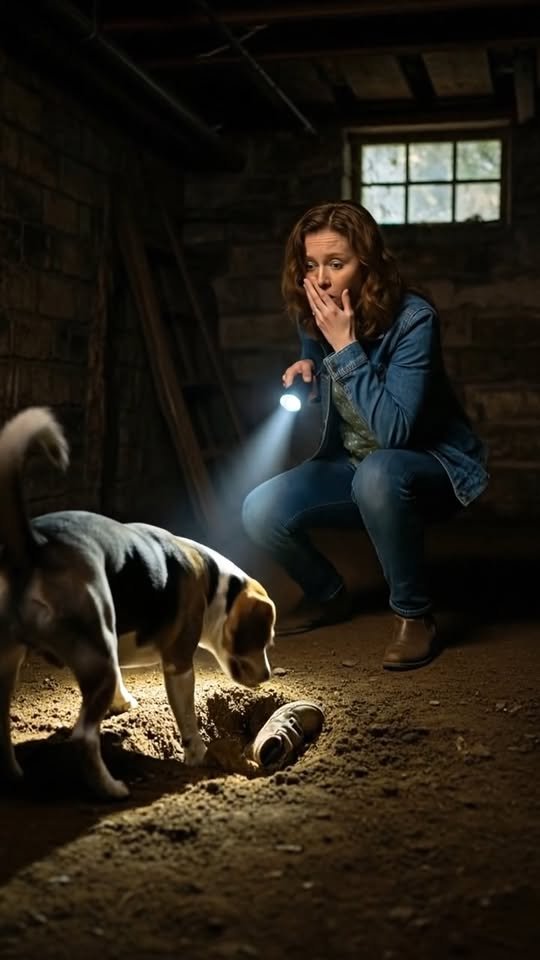
In the far corner, under a dusty, forgotten tarp, was Buster. He was digging, his paws a blur of motion, sending clumps of dark, packed earth flying. He was completely focused, barking wildly at the shallow hole he was creating.
“Buster, stop! What has gotten into you?” she cried, moving closer, her flashlight beam cutting through the darkness. She reached for his collar to pull him away.
Just as her fingers brushed his thick neck, he let out a triumphant yelp and pulled back, something dark and mud-caked clamped firmly in his jaws. He shook his head once, spattering mud across her jeans, then trotted directly to her. With his tail giving a single, proud wag, he dropped the object at her feet.
It wasn’t a bone. It wasn’t the rat. Her breath caught in her throat.
Her blood ran cold. She knelt, her flashlight beam trembling, and picked it up. It was a child’s sneaker.
It was old, caked with mud, the laces rotted away to mere strings. But as she wiped the grime from its side with a trembling thumb, she saw it. A faded, peeling decal of a cartoon rocket ship, and a worn, unmistakable red trim.
The world tilted, and twenty years collapsed into a single, horrifying second. She knew this shoe. She remembered the electric excitement in her eight-year-old cousin’s eyes the day his mother bought him his “new space shoes.” It was the exact shoe Daniel had been wearing on the last day anyone ever saw him.
The “monster” in the drawings wasn’t a fantasy. The scratching Noah heard wasn’t the house settling. The child and the dog had been right all along.
This basement wasn’t haunted by memories. It was a grave. A primal, cold terror, sharper and more real than any childhood fear of the dark, seized Sarah.
She scrambled back up the stairs, her flashlight clattering to the floor. “Noah!” she shrieked, her voice a ragged, unfamiliar sound. She grabbed her son, who was watching from the hallway with wide, frightened eyes, grabbed her car keys, and clipped the leash on Buster, who was now whining softly, his strange, urgent task complete.
She didn’t stop until they were all safely in the car, doors locked, speeding away from the house of horrors that had once been her home. A few blocks away, she pulled over to the side of the road, her body shaking uncontrollably. She fumbled for her phone and called the police, her voice a breathless, almost incoherent torrent.
“My cousin… he disappeared twenty years ago… his shoe… Buster dug it up… it’s in the basement… my son, he knew…”
The initial patrol officers who arrived were skeptical, but the shoe, so obviously old, so clearly a child’s, was a piece of tangible evidence they could not ignore. The house was cordoned off with yellow tape. Detectives arrived.
The excavation of the earthen basement floor began the next morning. They didn’t just find a shoe. Underneath the spot where Buster had been digging, less than three feet down, wrapped in a rotting tarp, they found the small, skeletal remains of a child.
Dental records provided a swift, heartbreaking confirmation. It was Daniel. Her father was brought in for questioning.
He began with a masterful performance of shock and grief, a concerned patriarch horrified by this grim discovery in the foundations of his own home. He blamed old construction workers from a renovation decades ago, transients, anyone but himself. But when the detectives, led by a sharp, empathetic woman named Isabella Rossi, presented him with the shoe, when they questioned why he had been so angry about Noah’s drawings, why he had been so adamant that the basement was “unsafe,” the cracks in his carefully constructed facade began to show.
Faced with the irrefutable, unearthed bones of his nephew, he finally, completely, broke. The story, when it came, was uglier than anything Sarah could have imagined. Daniel, a curious and clever eight-year-old, had accidentally stumbled upon something he shouldn’t have seen in his uncle’s study—ledgers and documents detailing a long-running embezzlement scheme.
In a fit of white-hot rage and panic at being discovered by a child, Sarah’s father had struck the boy, a single, fatal blow. He had buried the body that night in the basement, then created the cruel, enduring lie of the “runaway” boy that the family had been forced to live with for two decades. Her father was arrested, his reputation as a community pillar shattering into a million pieces of sordid scandal.
The family was broken, but in a strange, agonizing way, they were also set free from the toxic secret that had festered at their core for twenty years. Daniel, the lost boy, was finally given a proper headstone and a real burial, his name spoken aloud with love and sorrow for the first time in two decades. The old house, a crime scene tainted by an unimaginable darkness, was sold.
Months later, Sarah and Noah were in their new apartment. It was smaller than the old house, but it was bright and airy, filled with sunlight and the happy, untroubled sounds of a new beginning. Buster lay sleeping in a patch of sun on the floor, his paws twitching as he chased dream-rabbits.
Noah sat at the kitchen table, drawing. The monsters were gone. His pages were filled with colorful pictures of parks, of Buster chasing a ball, of him and his mom holding hands.
He was even drawing angels now, one of which had sandy-colored hair and wore red-trimmed space shoes. Sarah walked over and looked at a small, framed photo on a shelf. It was the only picture she had left of her cousin Daniel, a smiling, gap-toothed boy forever frozen at age eight.
“For twenty years,” she thought, her hand resting gently on Noah’s shoulder, “we were haunted. We thought it was by a ghost, but he was a prisoner, buried right under our feet, crying out for help.”
She looked at her son, then at the sleeping dog, her two silent, intuitive guardians. “We adults, lost in our logic and our grief, we were deaf to it.
But they could hear him. A boy who could see monsters, and a dog who could hear the secrets buried in the earth.” They had finally, miraculously, brought him home. She realized they hadn’t just sold a house.
They had demolished a tomb. And on the other side of the rubble, they were finally free to build a new life on a clean, solid, and unshakable foundation of truth.