



“Stay away from my house,” I warned, voice trembling but firm. “Come near us again, and I’m calling the police.”
She laughed. “Good luck.
Sell that house. You don’t fit here.”
Her dog barked loudly behind her. The boys flinched.
She glanced at them, her smile cruel. “Scared of a dog? Adorable.” She opened the door wider, letting the dog lunge forward.
The boys screamed and ran toward the street. “Stop!” I shouted, scooping Oliver into my arms and grabbing Finn. Her laughter echoed as we fled.
That night, I installed a security camera at the entrance. If she wanted a fight, she’d chosen the wrong mother. The next morning felt brighter.
Sunlight streamed through the curtains, sparking a flicker of hope. The boys giggled over their cereal. Oliver asked if they could play outside after breakfast.
“Sure,” I smiled. “Stay close to the house.”
They ran out, voices joyful—until Oliver’s scream shattered the air. “Mom!” he cried.
I dropped my mug and ran. The sight stopped me cold. Our yard was overrun with animals—a massive moose by the fence, antlers looming; raccoons scurrying across the grass; smaller creatures darting about.
“Inside!” I shouted, grabbing Oliver’s arm. Finn clung to me as we rushed indoors, my hands shaking as I locked the door. I checked the security camera footage.
My stomach twisted. A figure in a dark hoodie and mask crept across the yard at night, tossing bags of bait over the fence. Someone had lured the animals here.
I knew who. I called David overseas, voice shaking. “Someone threw bait in our yard.
It was full of animals this morning—dangerous ones! The kids were terrified. She’s escalating, David.”
“Calm down,” he said, voice sleepy.
“Don’t make it worse. Avoid conflict, please.”
“Our kids are being targeted, and you want me to do nothing?” I snapped. “I’m saying think long-term.
Don’t give her leverage.”
We hung up, his calm clashing with my fury. That afternoon, staring at the half-eaten pie I’d baked, I wondered if I was wrong. Maybe confrontation wasn’t the answer.
I packed the pie and walked to her house alone. No kids, no anger—just a chance for peace. I knocked, heart pounding.
She opened the door, eyes narrowing, then softening at the pie. “Truce?” she asked. “Yes,” I said, forcing a smile.
“Truce.”
She invited me in. Her living room smelled of incense, but it didn’t mask her sharp edge. Still, she gestured to the table, and I set the pie down.
“Peace offering,” I said. Her lips curved slightly. “Can’t resist pie.
Sit.”
We cut slices and sat. For a moment, the talk was civil. She asked about my boys, and I shared Oliver’s love for sketching and Finn’s fascination with fossils.
“I didn’t mean to offend the other day,” she said, her tone softer. “I just value quiet. Kids can be… loud.”
I gripped my fork.
“I get that, but insulting my boys crossed a line. They’re kids. They deserve to play.”
Her eyes flickered, almost understanding.
“Maybe I was too sharp.”
I exhaled, tension easing. Maybe this could work, I thought. Maybe she’s not all bad.
Then the baby monitor on my counter crackled. A piercing scream echoed. “Mom!
Mice! Everywhere!” Oliver’s terrified voice. I leaped up, nearly toppling the chair.
“What did you do?” I demanded. She leaned back, laughing. “Great pie.
Thanks, neighbor!” she called as I ran out. I sprinted home, heart pounding. Inside, the boys stood on chairs, pointing at dozens of mice scattering across the kitchen floor.
Oliver sobbed, clinging to Finn. I scooped them up, rage and fear twisting inside me. Later, I learned she’d paid a teenager to release the mice through a vent.
That was it. As I held my crying boys that night, one thought burned clear: She will pay. I sat with a lawyer at the dining table, papers spread out—complaints, timelines, camera evidence.
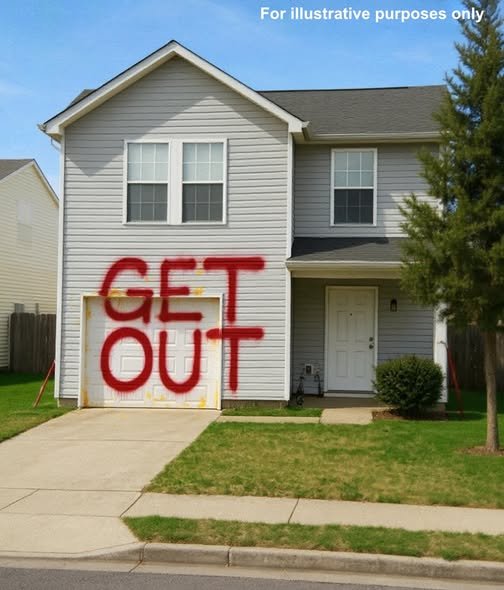
My voice shook as I listed her actions: the yelling, the graffiti, the dog, the bait, the animals, the mice. “She’s terrorizing us,” I said. “My kids are scared in their own home.
I want the police and courts involved.”
The lawyer nodded. “You have a solid case. We’ll file criminal and civil complaints.
It may take time, though.”
Before I could respond, a deafening crash shook the house. We froze. Shouting and smoke followed.
I ran outside. Smoke and dust rose from her property. Her house had partially collapsed.
Ignoring the lawyer’s shout, I ran toward the wreckage. The roof had caved on one side, walls tilting. Amid the chaos, I heard a faint cry.
“Help!”
She was pinned under a beam. For a moment, I thought of her cruelty—my boys’ fear, my sleepless nights. But instinct took over.
I grabbed the beam, straining. The lawyer helped, and we freed her. She coughed, dusty but alive.
Firefighters and medics arrived, pushing us back. Then, the rest of her house crumbled into rubble. She sat on the curb, shaking, face pale.
“Are you okay?” I asked softly. She shook her head. “Bruised, but fine.
My house—everything—gone.”
I hesitated, then said, “Stay with us until you find a place.”
Her eyes welled up. “After what I did to you? To your kids?”
“They deserve to see kindness, even after cruelty,” I said.
She refused at first, pride holding her back. But days later, she appeared at my door with a pie, eyes red, voice trembling. “I’m sorry,” she whispered.
“Inspectors said mice chewed through the foundation beams. My own trap destroyed me.”
I stared, stunned. “And insurance?” I asked.
She shook her head. “I was so focused on fighting you, I let the policy lapse. Nothing.” Her voice broke.
“That’s karma’s lesson.”
She stood there, not as the cruel neighbor, but as a woman broken by her own spite. “Stay,” I said. “Until you’re on your feet.
Let’s end this.”
Her lips trembled into a faint smile. The silence between us held not hatred, but the hope of peace.