


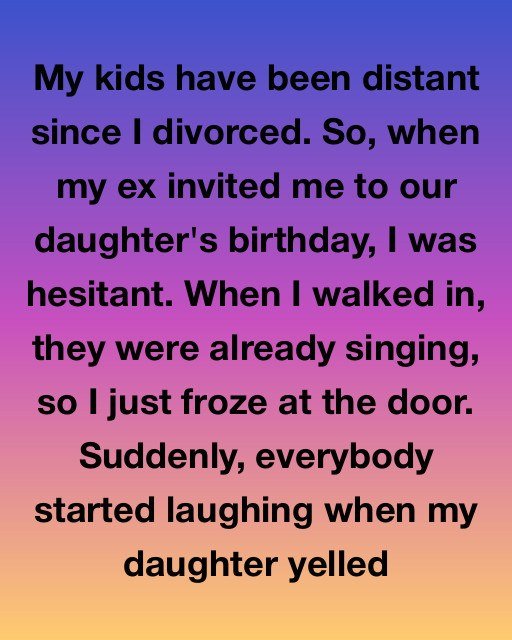
Or a trap.”
We both laughed—awkward, but human. Then she said the one thing I didn’t expect: “Thanks for showing up.”
I didn’t know how much I needed to hear that until she said it. Over the next weeks, I kept showing up in small ways.
Dropping off library books for my daughter. Buying Isaac frozen yogurt after his study group. Letting Nadia know before I came by.
Not asking permission—just being respectful. Being present. Then one afternoon, out of nowhere, Nadia called.
“Can you watch the kids next weekend?” she asked. “My sister in Glasgow needs help with the baby.”
“Overnight?” I asked, stunned. “Yeah.
I mean… you’re their mum.”
That weekend felt like stepping back into a life I thought I’d forfeited. We made disastrous pancakes, played board games, laughed until our sides hurt. Isaac even introduced me to “Rocket League,” which I was catastrophically bad at, but he explained patiently.
Patiently. Like he wanted to. That night, long after my daughter was asleep, Isaac came downstairs.
“Can I ask you something?” he said, curling beside me on the couch. “Anything.”
“Why’d you really leave?”
I felt that one like a punch. I took a long breath.
“Your mum and I stopped being good to each other. I thought leaving would make things easier for you two. Less fighting.”
“Didn’t feel easier,” he murmured.
“No,” I whispered. “I know it didn’t. And I’m sorry.
I never left you. Not for a second. I just… messed up the execution.”
He didn’t answer.
He just leaned his head onto my shoulder. “Goodnight, Mum.”
I held onto that moment like a lifeline. Things began to change after that.
Slowly, then all at once. I cheered at Isaac’s robotics competition. My daughter dedicated a school story to me: “Mum, who showed up again.” Nadia and I learned to talk like co-parents instead of enemies.
And then came the twist. I got an email from a woman named Rachel. Her son was in my daughter’s class.
Their kids were friends. She wanted to tell me something before it turned into gossip. She and Nadia had been dating.
I stared at the screen, stunned—not by the relationship, but by being the last to know again. When I called Nadia about it, she sighed in guilt. “I didn’t want to ruin what we were rebuilding,” she admitted.
“It doesn’t ruin anything,” I said. “I’m glad you’re happy. Just… don’t shut me out.”
She promised she wouldn’t.
And surprisingly, she kept that promise. Months passed. The kids spent every other weekend with me.
We went camping and got rained out. We roasted marshmallows over a candle in the car and laughed until we cried. Rachel and I even reached a gentle, mutual understanding—no competition, no awkwardness, just two adults orbiting the same children with care.
And one rainy afternoon, my daughter climbed into the backseat holding a drawing: all four of us together, under a crooked rainbow. “We’re still a family,” she said confidently. “Just… different.”
She was right.
Family isn’t defined by marriages or neat lines. It’s defined by showing up. By trying again.
By choosing love even after you’ve failed. So here’s to every parent learning to rebuild. To every kid brave enough to forgive.
To every second chance quietly offered and loudly earned. If this story moved you, share it. Comment.
Send it to someone who needs to hear that it’s not too late—not if they’re willing to show up again.