



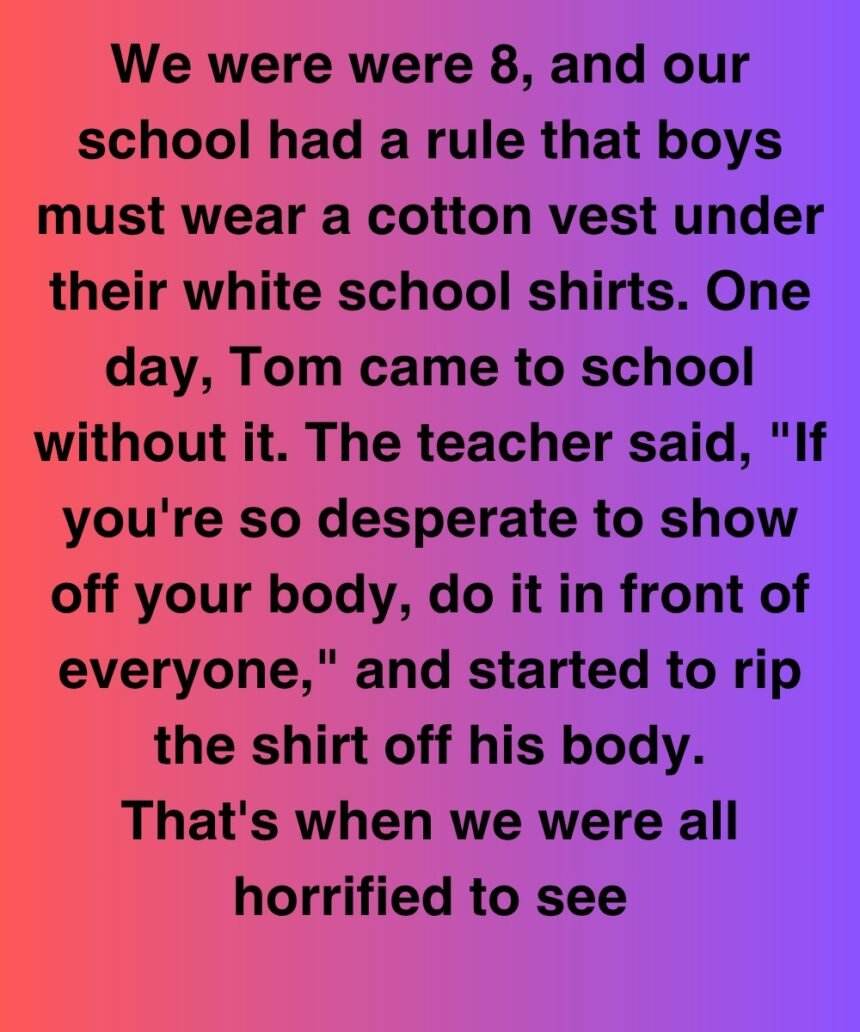
That’s when I knew he was faking it. Then, in 11th grade, something wild happened. Mrs.
Pereira, our favorite English teacher, announced the school was launching a peer mentorship program. Older students would guide younger ones through academics, stress, even stuff at home. Guess who they picked to lead it?
Tom. At first, he said no. Flat-out.
“I don’t want to be responsible for anyone,” he told me. “What if I mess up?”
But Mrs. Pereira didn’t push.
She just said, “Think about it. Someone probably showed up for you once. You could be that someone now.”
He joined.
The first kid they assigned to him was Naveen, a chubby little sixth-grader with big glasses and a constant cough. He barely spoke. And something about that quiet, awkward kid must’ve hit a nerve with Tom.
He didn’t tell anyone what happened in their sessions, but I could see it changed him. He walked taller. His fake smile was replaced by something real.
Naveen started participating in class more. He joined the science club. Won second place in a quiz competition.
His mom came up to Tom one day during a parent-teacher event and hugged him. Right there, in the middle of the hall. Everyone clapped awkwardly.
Tom turned bright red. From then on, he leaned into the mentorship role like it was his calling. He started speaking at school assemblies, gave talks on mental health, and even organized a donation drive for an NGO helping abused children.
But here’s where the twist comes in. During our final year, Tom was nominated for a regional youth leadership award. Big deal.
Full newspaper coverage, a fancy dinner, and even a cash prize. He was excited but nervous. “Feels weird getting rewarded for something that started with so much pain,” he told me.
Two days before the event, his father showed up at the school. None of us had seen the man since that day in primary school. He looked thinner, older, grayer.
He waited outside the gate until the final bell, then tried to approach Tom. The security guard stopped him, but Tom saw the commotion. He froze.
I was standing beside him and could literally feel his body go cold. Mr. Clive—still teaching, still gruff but gentler now—came out too.
The moment he saw the man, he stepped between them like a wall. “Not here,” he said. “Not like this.”
Tom looked at his dad, then at Mr.
Clive. “I’ll talk to him,” he said, voice like gravel. They stepped aside, near the old banyan tree.
I couldn’t hear much, but I saw everything. His father tried to hug him. Tom stepped back.
The man cried. Tom didn’t. Just kept his arms crossed.
After a while, he nodded once and walked away. His dad stayed there, slumped against the tree, staring at the ground. Tom never told us exactly what was said, but later he told me this: “I forgave him.
But that doesn’t mean he gets to be in my life. Forgiveness isn’t the same as forgetting.”
The award ceremony came and went. Tom won, gave a killer speech, and got a standing ovation.
He talked about resilience, about kids who grow up thinking love has to hurt, and how it doesn’t. He said one line that still gives me goosebumps: “We don’t get to choose our beginnings, but we can fight for a different middle.”
That hit. A few years later, Tom got a scholarship to study psychology abroad.
He wanted to become a child counselor. Said it was time to help the kids still stuck in the kind of home he escaped. Last I heard, he was running a center in Pune for youth therapy and trauma support.
His aunt Leena Aunty helps him manage it. Jamal did the website. Siya volunteers during holidays.
The rest of us donate when we can. That one awful moment in third grade—the ripped shirt, the bruises, the silence—set off a ripple. What could’ve broken him became the thing that built him.
Sometimes, I still remember that day in sharp flashes. The stunned classroom. Mr.
Clive’s shaking hands. Tom’s vacant eyes. But more than that, I remember what came after.
The quiet chips under the tree. The second-place quiz trophy. That hug in the school hall.
The banyan-tree standoff. And that line: “Forgiveness isn’t forgetting.”
Here’s what I’ve learned: you never really know what someone’s carrying under their surface. Behind the brightest smiles are sometimes the darkest stories.
But if even one person steps in, cares a little, listens a lot—it can change everything. So yeah, rules about cotton vests? Those are forgettable.
But people like Tom? Unforgettable. If this story moved you even a little, hit that ❤️ and share it.
Someone out there might need it more than you think.