


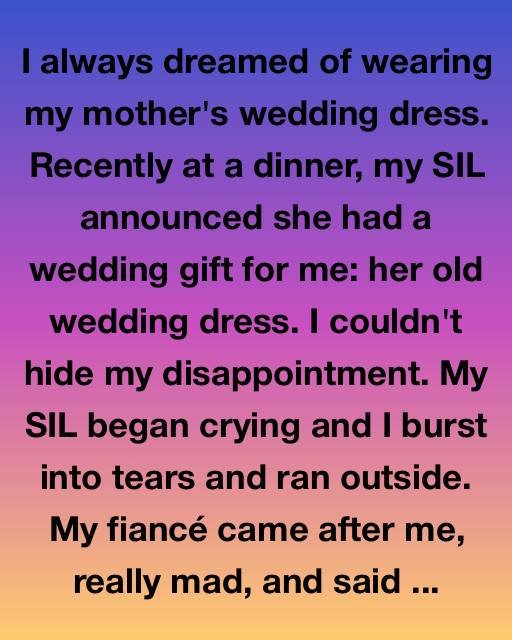
It wasn’t her dress. It was my mother’s wedding dress. “I found it,” she said, smiling through tears.
“Your dad still had it in a box in the attic. He thought he’d given it to you already, but apparently he’d put it away years ago and forgot. I called him last night after your message and… he drove it over this morning.”
I gasped, covering my mouth.
My hands trembled as I opened the bag and saw it—ivory, lace, still beautiful, still my mom. “I’m sorry,” she said, taking my hand. “I had no idea how important this was to you.
I just wanted to be part of your day.”
I hugged her. I cried harder than I thought I would. It wasn’t just about the dress.
It was about feeling seen. Feeling understood. Later that evening, I sat down with my fiancé and told him everything.
The talk with his dad. The moment with his sister. And finding the dress.
He was quiet for a long time. Then he said, “I didn’t know. I guess I thought you were being dramatic.”
I smiled gently.
“I know. But I wasn’t. Not this time.”
He reached for my hand.
“I’m sorry. I want to understand you better. I really do.”
And something shifted in that moment.
Not everything, not all at once—but something real. He started asking questions. About my mom.
About what kind of wedding I really wanted. About what mattered to me, beneath the to-do lists and guest counts. We started planning things more intentionally.
We scaled back the venue. We added a tribute table with photos of our parents and grandparents. We even wrote our own vows.
But here comes the next twist. A few weeks before the wedding, I got a call from my father. He sounded strange.
Nervous. “I need to tell you something,” he said. “About the dress.”
I froze.
“What about it?”
“It wasn’t actually your mom’s wedding dress,” he said, sighing. “It was the one she wanted, but we couldn’t afford it at the time. After she passed, I found it at a vintage store years later and bought it, thinking maybe… one day you could wear it.
I thought it would be close enough.”
I sat there, stunned. “So whose dress was it originally?”
“I don’t know. Just some woman who sold it to the shop.”
It hit me like a wave—I had built years of dreams around a dress that technically never belonged to my mother.
At first, I didn’t know how to feel. But then I remembered something George said that night on the bench. “It’s not about the fabric.
It’s about the memory.”
And in a strange way, the dress still held her spirit. It was the one she wanted. It was the one I saw her eyes light up for in that photo album I found years ago.
So maybe it wasn’t about whose name was on the tag. Maybe it was about the dreams she had—and how they became mine. The wedding day came.
The sun was warm, the breeze kind. I walked down the aisle in a dress full of memory, sewn with hope and patched with grace. My fiancé—now husband—watched me like I was the only person in the world.
After the ceremony, my sister-in-law hugged me and whispered, “I’m so glad it was your dress after all.”
But even that wasn’t the end of the story. A few months later, I was sorting through boxes in our new home when I found a small envelope tucked between photo albums. It was addressed to me, in my mother’s handwriting.
Trembling, I opened it. Inside was a note, written years ago:
“If you ever wear this dress, know that I am with you. Not in the fabric.
Not in the lace. But in every step you take toward love. Don’t chase perfection.
Just chase peace. That’s where I’ll be.”
I sobbed like a child. That letter had been there all along.
And suddenly, everything made sense. The dress. The mix-up.
The fight. The healing. The unexpected gift.
The truth. It wasn’t about getting what I planned. It was about receiving what I needed.
There was a quiet kind of grace in that—how life doesn’t always unfold the way we want, but sometimes, if we’re willing to soften, to listen, to love—it gives us something better. My sister-in-law and I became closer after that. The kind of close that doesn’t come from blood, but from understanding.
My husband and I grew, too. We learned how to pause before speaking. How to ask before assuming.
How to forgive without keeping score. And that dress? It’s now in a new box, tucked away safely in our closet.
But more importantly, the note is framed on our bedroom wall. It reminds me every morning that love isn’t about the perfect moment. It’s about choosing each other—even when the seams don’t quite line up, even when the lace is borrowed, even when the dream changes halfway through.
If there’s one thing this story taught me, it’s this:
Life is stitched together by a hundred little misunderstandings, a dozen unexpected turns, and a few generous second chances. But if you look closely, there’s always beauty in the mending. So, to anyone holding onto an old dream, or facing a messy misunderstanding—
Let go of the perfect picture.
And hold tight to the heart of it. That’s where the real story begins. If this story touched you, give it a like and share it with someone who might need a little reminder that life’s surprises can be beautiful, too.