



“What do you mean?”
“He became upset when asked to paint something cheerful,” Ms. Burns said, exchanging a glance with Mr. Doyle.
“Instead, he drew something quite… disturbing.”
“Disturbing?”
Mr. Doyle slid a piece of paper across the table. On it was a crude drawing—Jacob’s, I could tell immediately.
It showed a small figure standing behind bars, with dark shapes looming above. My heart twisted. “He told another student,” the principal added quietly, “that this is what his classroom feels like.”
I stared at them, speechless.
“He’s a sensitive boy,” I finally managed. “We just moved. He’s trying to adjust.”
Ms.
Burns nodded sympathetically. “Of course. But we’ve noticed other behaviors too—hesitation when certain staff members approach him, reluctance to eat during lunch, and once, he hid in the supply closet during recess.”
My stomach dropped.
“What? Why would he do that?”
“We’re not sure,” she said evenly. “Perhaps anxiety.
But we’re concerned it might be more than that.”
“More than that?” I repeated, feeling a chill creep up my spine. Mr. Doyle leaned forward.
“Mrs. Turner, we think it would be beneficial for Jacob to see the school counselor. Sometimes children internalize things they can’t express.
It could help us all understand what’s troubling him.”
I nodded slowly, my thoughts spinning. I wanted to help Jacob, of course—but the way they spoke, the way they seemed so sure something was “wrong” with him, felt off. After the meeting, I stepped out into the hallway, trying to gather my thoughts.
I was heading toward the exit when I heard someone call softly, “Mrs. Turner?”
I turned and saw a man standing near a janitor’s cart. He was middle-aged, with kind eyes and a weathered face.
His blue uniform was faded, and his name tag read “Mr. Harris.”
“Can I talk to you for a second?” he asked, glancing around nervously. “Of course,” I said, confused.
He stepped closer, lowering his voice. “Don’t believe everything they told you in there.”
I blinked. “What do you mean?”
“They’re lying to you,” he whispered.
“About your boy.”
My heart skipped a beat. “What are you talking about?”
Mr. Harris looked around again before speaking.
“I’ve been here a long time, ma’am. Long enough to notice things that don’t add up. Your son—Jacob—isn’t the first kid to act like this.
The same thing happened with another student last year.”
My pulse quickened. “What happened to them?”
He hesitated. “The boy’s parents withdrew him.
Never said why. But before they left, his mother came to me, crying. Said her son told her something bad was happening in class—something he was too scared to talk about.”
I felt the color drain from my face.
“Are you saying someone at this school hurt him?”
Mr. Harris sighed, his expression heavy. “I can’t say for sure.
But I know kids don’t just change like that without a reason. Keep an eye on your boy. And whatever you do, talk to him—away from here.”
Before I could ask more, he gave me a quick nod and walked off, pushing his cart down the hall.
I stood frozen, my mind racing. That night, I sat on Jacob’s bed again. He was curled up with his stuffed bear, staring at the ceiling.
“Jacob,” I said softly, “you know you can tell me anything, right?”
He nodded slightly, but didn’t look at me. “Your teacher said you’ve been hiding during recess. Is something going on at school?
Did someone say something to you?”
He bit his lip. For a long moment, I thought he wouldn’t answer. Then he whispered, “I don’t like Mr.
Doyle.”
My heart thudded. “The principal?”
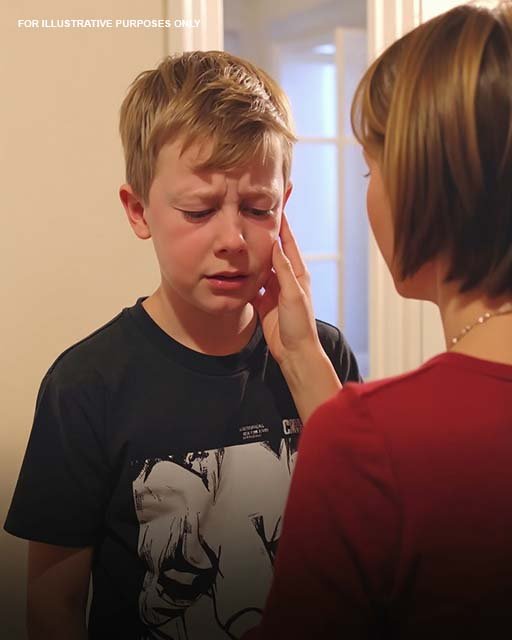
He nodded again, eyes filling with tears. “He gets mad when I talk too much.
He said if I tell anyone what he does, I’ll get in trouble.”
A cold shock went through me. “What does he do, Jacob?”
He didn’t speak—he just shook his head and buried his face in his pillow. I sat there, trembling, unsure what to do.
I didn’t want to push him, but every instinct in me screamed that something was terribly wrong. The next morning, I decided to keep Jacob home from school. I called the office and said he was sick.
Then I started making calls—to the district, to a child psychologist, even to a friend who worked in education. But the more I tried to get information about Mr. Doyle, the more resistance I met.
“He’s been with the district for over twenty years,” one administrator said dismissively. “There’s never been a complaint against him.”
But the way she said it made me wonder if that was true—or if the complaints had simply been buried. That afternoon, I went back to the school.
Not to meet anyone this time, but to find Mr. Harris. I caught him in the hallway during lunch break.
“Mr. Harris,” I said urgently, “I need to know what you meant yesterday. You said something was happening to the kids.”
He looked torn.
“Ma’am, I could get fired for talking to you.”
“Please,” I pleaded. “I just want to protect my son.”
He sighed, glancing down the hall. “There’s a storage room next to the counselor’s office.
It’s been locked for months, but sometimes I see Mr. Doyle take kids in there. Says it’s for private talks.
But that door—” He hesitated. “It locks from the outside.”
My stomach lurched. “Have you told anyone?”
He nodded grimly.
“I did once. They told me to keep my nose out of it.”
That was enough for me. The next day, I filed a report with the district and the police.
They said they’d “look into it,” but I wasn’t waiting around. I withdrew Jacob from the school immediately and began homeschooling him until I could find a safer alternative. For weeks, I heard nothing.
Then, one afternoon, I received a call from a detective. “Mrs. Turner,” he said, “we’ve investigated the situation at Redwood Elementary.
We found evidence that supports your concerns.”
Apparently, several parents had come forward after my complaint, each with eerily similar stories—children who had become withdrawn, anxious, or terrified to attend school. Mr. Doyle had been using that “storage room” for his so-called “disciplinary sessions,” though what exactly occurred there was still under investigation.
Mr. Harris’s statement helped open the case. He was the one who gave the detectives the key logs and video footage from the hallway cameras—evidence that Mr.
Doyle had indeed been locking children inside that room. He was arrested a few days later. When I told Jacob, he didn’t say much.
He just hugged me tightly and whispered, “I told you he was mean.”
I held him close, tears stinging my eyes. “You’re safe now,” I whispered back. “I promise.”
It took months for him to start smiling again.
We moved to another town not long after, and I made sure to visit his new school personally before enrolling him. He still hesitates sometimes when adults raise their voices, but he’s healing—slowly, bravely. As for Mr.
Harris, I sent him a thank-you letter. Without his courage, I might never have known the truth. He replied once, in shaky handwriting:
“Some people clean floors.
Others clean up lies. I just did what was right.”
I still keep that note in my desk drawer. Looking back now, I often think about how easily the truth could have stayed buried—how many children’s voices go unheard simply because adults choose convenience over courage.
When the school first summoned me, I went there expecting to defend my son’s behavior. Instead, I uncovered a truth that changed everything I thought I knew about trust, authority, and the hidden corners of childhood. And every night, as I watch Jacob sleep peacefully, I remind myself of one thing:
Sometimes, it’s not the children who misbehave.
It’s the adults who do the wrong things—and teach kids to keep quiet about them. And if not for one brave janitor whispering, “They’re lying to you,” I might never have found out the truth at all.