



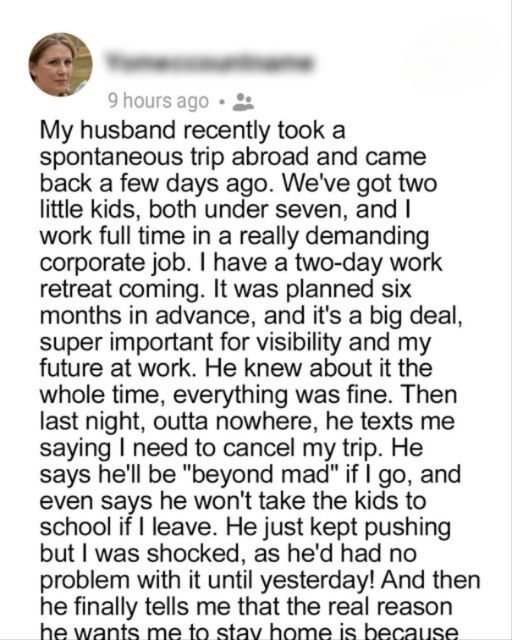
I had to make my feelings known, even if it was uncomfortable. His reply came swiftly: “I’m just saying I need support right now. And if you go, I’m going to be left holding everything.
The kids, the house, the work. I’ll be stuck doing it all. And I can’t do it anymore.”
I couldn’t believe what I was reading.
“You can’t do it anymore?” I texted back. “I’ve been holding down the fort for months while you travel, and now you’re telling me you’re overwhelmed for two days? You think you can just control my life like this?”
The silence that followed was deafening.
I sat there, staring at my phone, wondering if I had said too much. Part of me feared that this was a breaking point for our marriage. We had been through our ups and downs, but this was something new.
This was a side of him I hadn’t seen before—a side that demanded I give up something important to me for his own convenience. When he finally responded, his words were different. “I’m sorry.
I shouldn’t have said that. But I just feel like I’m losing you. It’s like you’re always working, always doing something else.
You’re never around when I need you.”
His words hit me harder than anything else. I had been so focused on building my career, working late hours, and ensuring I was making a name for myself that I had neglected him in ways I hadn’t realized. The guilt immediately set in, and I could hear the pain in his message.
I took a deep breath and put my phone down for a moment. Was I really doing that? Was I so wrapped up in my own ambitions that I was leaving him behind?
I knew how important our relationship was, but I couldn’t help but feel resentful that I was being asked to choose between my career and my family—something that seemed so out of balance. Finally, I typed, “I understand you’re feeling neglected, and I’m sorry for that. But I can’t cancel this.
It’s too important for me. But I also don’t want to make you feel unsupported.”
He replied with a simple, “I know. I’m sorry.
I didn’t handle it well. I just… I just need you to understand how I’m feeling.”
There was a heaviness in his words, but something about them made me pause. I realized that what he needed wasn’t just time with his friends, but reassurance from me that I hadn’t forgotten about him.
Maybe I had been so focused on what I needed to do for myself that I had neglected to check in with him, to make sure we were still on the same page. “I can’t cancel the retreat, but I promise I’ll do better. I’ll be more present when I’m home.
And I’ll make sure we spend more time together as a family, not just when it’s convenient, but when it matters,” I texted. His response was quick this time. “Okay.
I get it. I don’t want to stand in your way. I just want us to be okay.
I’m sorry.”
I didn’t know where this conversation would lead, but it felt like the first real conversation we’d had in a long time. He wasn’t just angry anymore. He was hurt.
And as much as I didn’t want to admit it, I realized I had been too focused on the future, on work, on everything outside of our relationship, and I had left him behind in the process. The next few days were a blur. I went on my retreat, and while I was there, I made a conscious effort to check in with him.
I sent him little texts about how things were going, how I was feeling, even though the retreat was packed with work. I made sure to call him every evening, and we talked about our day, our kids, and how we were both feeling. It felt good to reconnect, even from afar.
When I got home, he was waiting for me at the door. He gave me a big hug, and as he pulled away, I saw a softness in his eyes that hadn’t been there before. “I missed you,” he said.
“I missed you too,” I replied, feeling the weight of everything that had been unsaid between us finally start to lift. That night, we stayed up late, talking and sharing our thoughts, our concerns, and our hopes for the future. It wasn’t just about the retreat anymore.
It was about finding a balance between our careers and our relationship, about making sure we both felt valued and heard. The next few weeks were filled with small changes—better communication, more quality time together, and a renewed sense of partnership. I knew there would still be challenges ahead, but I also knew that this was the start of something better.
We had learned that the key to making everything work wasn’t about sacrificing one for the other—it was about making space for both. If you find yourself in a similar situation, remember that it’s not about perfect balance every single day. It’s about being there for each other, even when life gets busy, and making sure that you both feel supported, loved, and understood.
Relationships take work, but when you’re willing to invest in them, they’ll return that effort in ways you can’t even imagine. Share this story if you believe that balance and communication can make all the difference. Sometimes the smallest conversations lead to the biggest changes.