


I always hated my father because he was a motorcycle mechanic, not a doctor or lawyer like my friends’ parents. The embarrassment burned in my chest every time he roared up to my high school on that ancient Harley, leather vest covered in oil stains, gray beard wild in the wind. I wouldn’t even call him “Dad” in front of my friends.
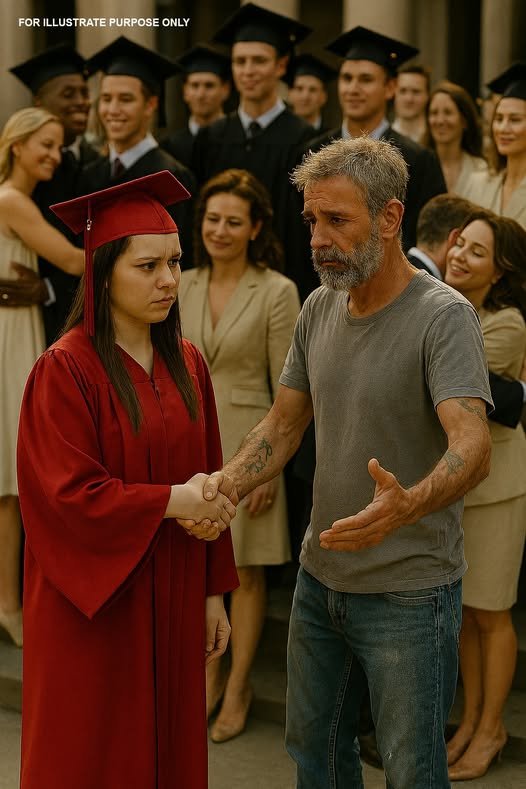
The last time I saw him alive, I refused to hug him. It was my college graduation, and my friends’ parents were there in suits and pearls. Gavin showed up in his only pair of decent jeans and a button-up shirt that couldn’t hide the faded tattoos on his forearms.
When he reached out to embrace me after the ceremony, I stepped back and offered a cold handshake instead. The hurt in his eyes haunts me now. I grew up in a house that smelled perpetually of motor oil, gasoline, and something faintly metallic that always clung to my father’s clothes.
He would spend hours in the garage, the clang of wrenches and the hum of engines filling every corner of the neighborhood. My mother had left when I was ten, citing “irreconcilable differences,” but what I remember most was her sigh as she walked out, her heels clicking against the cracked linoleum. I never asked her to stay.
I was already ashamed enough of my father that I didn’t want anyone else involved. School was a battlefield. I learned early that children are cruel in subtle ways.
Teachers sometimes praised my friends’ parents—their wealth, their sophistication, their careers. I would lie about mine. “Oh, my dad works in finance,” I’d say, letting the words slip from my lips like a practiced lie.
I avoided friends at my house and hid my father’s gifts and trinkets that he made for me. There was the model airplane he spent three weekends sanding, gluing, and painting, and the carved wooden jewelry box he gave me for my twelfth birthday. I stashed it in a closet and told myself that appreciation was overrated.
Gavin, despite his rough exterior, loved me fiercely. I didn’t understand love the way a child should. He never pressured me to be someone I wasn’t.
He listened when I talked, though I often spoke with venom masked as indifference. Once, when I was fourteen, I had invited friends over for a small gathering. Gavin had spent the morning cleaning the garage and polishing the Harley to show them.
When they arrived, they made small noises of disgust at the smell. I laughed along with them, a sharp, biting sound I can still hear in my nightmares. He didn’t say anything.
He just looked at me with those gray eyes, tired but patient. I think he knew that the real battle was with myself. College was supposed to be my escape.
I applied to schools far away, and when I was accepted into one of the most prestigious programs, I felt a wave of triumph that I mistook for validation. I would finally belong to the world of polished parents, dinner parties, and professional legacies. Gavin cried when I left.
I remember the night before my departure: he parked the Harley outside, walked me to the curb, and handed me a small package wrapped in brown paper. Inside was a tiny, hand-carved compass. “So you don’t get lost,” he said.
The story doesn’t end here — it continues on the next page.
Tap READ MORE to discover the rest 🔎👇