


I smiled politely and tucked it into my bag, later tucking it deep into a drawer where it would never see the light of day. I lived in a bubble of ambition, barely speaking to him over holidays or breaks. My pride was a protective layer I wore like armor.
I wanted to be the daughter everyone envied, and having a father who worked with greasy engines didn’t fit that image. Each time he sent letters or gifts, I answered with courtesy, never warmth. I thought I was being clever, shaping myself into someone acceptable.
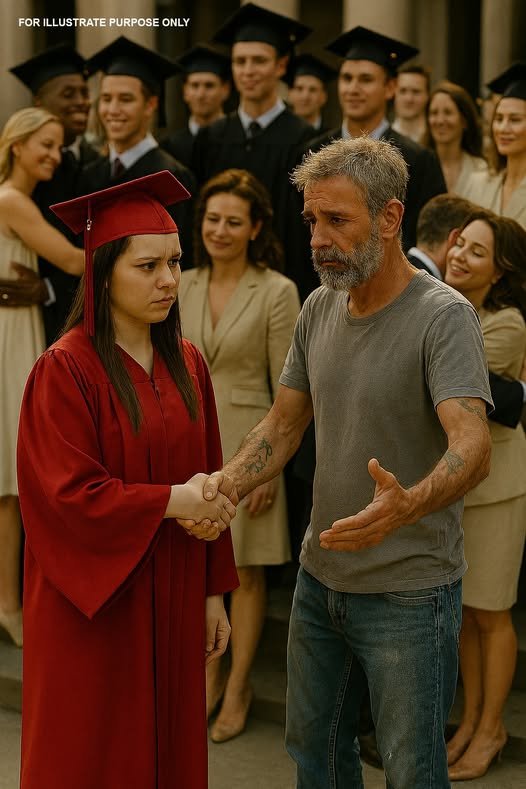
I was cruel without knowing it, though I convinced myself otherwise. The graduation day came, and I had rehearsed the moment endlessly. When Gavin arrived, his jeans slightly frayed at the bottom and the button-up shirt wrinkled, I felt the familiar prick of shame in my chest.
My friends’ parents smiled and congratulated me, their arms ready to hug me. I allowed myself to melt into the polished fabric of their approval. When Gavin approached, I did the unthinkable: I offered a handshake instead of the embrace I should have given.
The memory of that brief, stiff moment has followed me like a shadow ever since. After graduation, life moved on with all the speed of an engine revving to its limits. I secured a position at a prestigious law firm, climbed the ladder quickly, and surrounded myself with people who understood propriety and presentation.
Gavin’s birthday letters arrived less frequently, and eventually, they stopped altogether. The void left by his absence was something I ignored, believing my success was payment enough for past transgressions. It wasn’t until years later that reality caught up with me.
My apartment was quiet, filled only with the hum of the city outside and the ticking of an old clock I had rescued from a flea market. I was sifting through a box of memorabilia, curious about what remnants of my past I had buried, when I stumbled upon the compass he had given me. Dust covered its surface, and the engraving of his initials had faded slightly.
I held it in my hand, feeling the weight of both the metal and the years of regret I had carried without acknowledgment. Tears came unbidden. The walls I had constructed to protect myself crumbled in that instant.
Memories flooded back—afternoons in the garage, his hands patiently guiding mine as I learned to hold a wrench, evenings spent listening to stories of his youth, the quiet pride in his eyes when I finally mastered a difficult task. I remembered the sacrifices he had made so I could go to school, the long hours working to provide a life I could claim with such arrogance. I had been blind, and now, painfully aware.
I tried to find him then, but the search led to the worst discovery: he had passed away a few months after my graduation. A heart attack, sudden and merciless. The funeral was small, attended mostly by neighbors and a few friends from the garage.
No one I knew from college was there. They hadn’t known him, and neither had I—not really. The letters I never answered, the gifts I ignored, the moments I had dismissed as inconsequential were now lost forever.
Grief settled into my chest like a heavy, unyielding weight. I wandered through his workshop, now silent, every tool and oil stain a reminder of the life I had mocked. The Harley stood in the corner, polished and gleaming despite years of neglect.
I ran my hands along the seat, and for the first time, I truly missed him, not the embarrassed father, but the man who had loved me so unconditionally, whose pride in me never faltered even when I faltered in return. I began to write letters to him, though I knew they would never reach him. I told him about my successes, my failures, my regrets, and the emptiness that had grown in his absence.
I confessed to the cruelty I had inflicted in my youth, the arrogance that had blinded me, the love I had failed to recognize. Each word was a step toward some fragile understanding of myself, a fragile attempt at redemption. In time, I started volunteering at a local youth center, helping children with projects and mentorship, teaching them skills my father had taught me in his garage.
I spoke about engines and mechanics, about problem-solving and patience, and often, without realizing it, I would mention him. The children didn’t care about his tattoos or his oil-stained vest. They cared about the lessons, the care, and the time he had given me.
In sharing him with others, I felt as though a part of him lived again. I kept the compass on my desk, a permanent reminder of the man I had failed to appreciate while he was alive. Sometimes, I would hold it and close my eyes, imagining the warmth of his hands, the rough calluses, the quiet encouragement.
It became a ritual, a way to feel close to him and to honor him in the only way I could. Years have passed, and I have learned to carry my regret without letting it consume me entirely. I have built a life that, in part, reflects him—the patience he taught, the integrity he embodied, and the quiet strength that never faltered despite my rejection.
Yet the memory of that cold handshake remains, etched into the deepest corners of my heart, a reminder of the human flaws we all carry, and the love that endures even when it is unrecognized. I sometimes wonder what he would think of me now. Would he forgive me?
Would he be proud despite my arrogance? I like to think he would smile, that familiar crooked grin under the gray beard, and nod, as he always did. And I imagine him saying, “You’re finally finding your way, kid.”
It took losing him to understand the true measure of love and pride, lessons I had squandered in my youth.
But in the quiet moments, with the compass in my hand and the memory of his laughter in my mind, I feel him still guiding me, steady and unwavering, as he always had. And for the first time, I allow myself to call him by the name I should have always used: Dad.